Why Women Don’t Want to Work Here

The recent publication of the results of a longitudinal study of PhD students in chemistry in the UK (in PDF form here) has received a lot of attention in the press. The figures look bad, and highlight the enormous gender gap that persists in higher education; by the third year of PhD studies, the percentage of male students who wished to continue on an academic career path dropped from 61% to 59% — but for women, the drop is from 72% to 37%.

Curt Rice writing for the Guardian asks the all-important questions “How can it be this bad? Why are universities such unattractive workplaces?” The possible answers to this are many and varied, of course, but the report shows that many women are deterred by the ‘macho’, competitive and solitary nature of the academic life.

Perhaps we need to take a deeper look at our work environment to understand how we ended up where we are. I’m sure many of you would agree that the academic career path has become harder to navigate. The ‘perpetual postdoc’ problem has increased as permanent lectureships or research posts are thin on the ground, and talented researchers are pushed out of academia as they seek to avoid casualised insecure employment (perhaps because they wish to start a family or buy a home). The long-hours culture also takes its toll and makes our profession less attractive to many. All these pressures have a disproportionate impact on female colleagues.

Instead of addressing these inequalities university managers focus on such things as getting us higher up the university rankings or obtaining ever-larger research grants. In this context, the current hiring practices of universities make a lot more sense: they are driven by a need to make tables of arbitrary numbers go up (in league tables, departmental rankings, and finance reports), and the human cost is invisible or secondary.

At this University the decision to focus on achieving a top 50 world ranking (discussed in my previous blog post) has produced hiring practices directed at snatching up ‘research leaders’, rather than developing our own staff and offering them opportunities to shine.

UCU are pushing for improvements in the working environment at this institution. We have held informative workshops, created a Fixed-Term Contracts Working Group, pushed for  negotiation on the Academic Reward and Recognition project, and sought your input and feedback. But on a broader level, we face challenges extend far beyond the borders of this  institution. We have an academic culture now so focused on short-term goals and externally imposed metrics that it is tearing itself apart. Gender inequalities are just part of the evidence for this; clearly our institution fails to attend to the barriers facing women here. But we are also so pushed to seek grant funding that we give no time to the plight of postdocs on casualised contracts who we fail to develop and who have little hope of advancement or job security.

We need a work environment and culture that develops and nourishes its staff, and supports enthusiasm, intellectual vitality and academic freedom. Instead we often offer a workplace which forces all of its members to give up their lives and families to focus on short-term goals. This promotes gender inequality and produces an exploited academic underclass. We know why women can’t and don’t want to work in these environments. We know it is not good for them or anyone. Isn’t it time we did something about this?

——-

Eric Silverman (President) and Catherine Pope (Equalities Officer)


USS – changes in pension tax. Are you affected?

Many universities will have had members receive letters from USS recently regarding a tax issue with those who bought Added years AVC’s during the USS PiP year 2011/12 (which ran to March 31st 2012).   This is a complex issue.

As it appears that there was very little consultation or publicity regarding these changes we thought we’d provide you with a helpful summary of the key points.  (please note the information below is courtesy of Edinburgh UCU)


Who Is Not Affected?

Folks who have cash Additional Voluntary Contributions (AVC’s) from Prudential. People who bought their Added-Years AVC’s from USS before April 1st 2011.

What’s Going On?

HMRC recently ruled that they would, for tax purposes, include all the added years contracted for in an Added Years AVC within the tax year they were contracted.

Huh?

If you bought five Added Years contracted to be paid for over ten years, the taxman isn’t counting just six months of it in each of the ten tax years, but all ten, plus the one year you normally accrue, within the year you took out the AVC.

Why Is That a Problem?

Up until April 1st 2011, the tax allowance for pensions was 255,000 Pounds. In the current tax year, that dropped to 50,000 Pounds. So now you don’t need to be rich to get hit with a tax bill for pensions.

So What’s Happening?

This all appeared at rather short notice given that the end of the USS pension year is March 31st. To prevent anyone getting hit with a tax bill, the University Pensions Office has withheld the March AVC pensions contribution from the March salary.

How Does That help?

It prevents you being hit with a tax bill if you stop your AVC contract this year, and restart it next year. That’s because then only the Added Years you actually bought in 2011/12 would be counted towards tax, and not all the future years you contracted to buy.

Won’t Stopping The Contract Lose Me My Inflation Protection?

USS have said they’re willing to restart contracts in April for those who contact them early enough (within three months of receiving their letter from USS) and that they’ll honour the terms of the previous contract. So if you took out the original Added-years AVC contract before October 1st 2011, you’d have had the full inflation protection built into it, and USS will keep that if you take up the option to restart the contract from April 1st 2012.

But We’ll Have The Same Problem Again Next Year?

Minus one year’s contributions, yes, if you take out the same contract.
However, USS are also offering a tweak to the contract where you’ll be liable each year only for the added years you actually buy in that year.
All other features, including inflation protection, will remain the same. So if you take that option (within three months of receiving your USS letter) then the problem won’t repeat.

So I should do That Then?

Pensions are never quite that simple. The fly in the ointment here is that it could be that you’d really want to take the tax hit for 2011/12, particularly if that tax hit is low, or even zero.

Why Would I Want To Take a Tax Hit?

Because then you’d have paid off the tax for your entire Added-Years AVC contract, and it’d never be counted against your 50,000 Pounds annual limit again.

That’s a Good Thing?

Your normal accrual of pension (one year per working year) counts against that 50,000 annual limit. Nearer retirement, you might want to start putting aside more money into a cash AVC, which also counts towards the annual limit, and essentially you’d want as much leeway as possible to save as much as possible in your last few working years.

Eliminating the Added-Years AVC from future tax liability would give you some extra leeway. Besides, the government could bring that 50,000 Pounds limit lower in future years, so any extra leeway gained now could turn out to be a very good thing later.

Right. So How Do I Know If I’m Affected?

USS are currently doing calculations for the folks who they believe may be affected and sending out letters with details. After you see those calculations, you can make a decision.

What Decision?

You have four options:

A) Let the contract for 2011/12 lapse with the missing March payment, and let our Pensions folks know quickly in April that you want to restart the contract in 2012/13. USS will restart the contract on the same terms with one less year to go. You’ll have missed one month’s payment but otherwise things will continue as before.

B) Do as in (1) but on the new contract offered by USS which has the tweak to ensure this won’t happen every March.

C) Let the local Pensions folks know that you wouldn’t have to pay tax anyway, and you’d rather just keep the contract going from when it started in 2011/12. That way you’ve taken the whole tax hit (of zero or some small amount) already and have given yourself some leeway in your annual limits in future. A double contribution would be taken from your salary in April to make up for the missing March contribution.

D) Quit the AVC contract, in which case it will have ended on February 29th 2012, with whatever Added Years you had already bought. Hopefully this isn’t all so much trouble that people would want to do that.

Whichever way you want to go, you do need to tell the folks down at the local Pensions office. Wait until you see your calculations from USS though.

What If I Want to Do My Own Calculations?

I’m assuming for the following that you now have your letter from USS.

1) Get your “Final Salary” for the date 01/04/2011. This is given at the start of the second “Schedule I” calculation in your USS letter. (for year 2011/2012)

2) Get your “Years of Service” at that date from the same place.

3) Multiply that “Final Salary” (1) by 19. Divide the result by 80 and then multiply by the “Years of Service” (2). You may need first to convert the days into a decimal fraction of a year by dividing them by
365 and adding the decimal fraction to the number of whole years to give Years of Service as a real number.

4) Index the result in (3) by CPI. This was 3.1% in 2011/12 so multiply
(3) by 1.031 This gives you your “Start Value” for the year 2011/12.

5) Get your “Final Salary” at 01/04/2012 is given from the start of the first “Schedule I” calculation on your USS letter.

6) Take the total number of Added Years you contracted for last year.
(this will stated on your contract). Then add the service accrued on
01/04/2011 (2) to this. Then add 1 to that total (assuming you’re full-time). This gives you the Years of service accrued on 01/04/2012 for tax purposes.

7) Multiply the final salary from (5) by the Years of Service from (6).
Divide the result by 80 and then multiply by 19. This gives you your “Closing Value for the year 2011/12

8) Subtract (4) from (7). Then add in the total cash you’ve put in to any cash AVC’s (that’s into the Prudential USS one and into any stakeholder or other pension funds). You don’t need to add in interest or dividends, or capital gains from these, just the cash you put in.

This gives you the total used for tax purposes in 2011/12.

9) If that total is less than 50,000 Pounds, then you’re fine. There’s no tax to pay.

10) If it is above 50,000 Pounds then all is not lost, because you can use the unused parts of the 50,000 Pounds allowances from the previous 3 years.

11) The used portions of your 50,000 Pounds allowance for each of the years 2008.2009; 2009/2010; and 2010/2011 are given at the end of the relevant “Schedule I” calculations in your USS letter. To get the unused tax allowance for each year, simply subtract each used allowance from 50,000 Pounds.

12) Total up the unused tax allowances for years 2008/2009, 2009/2010, and 2010/2011.

13) If the spare allowances from those three years are greater in aggregate than however much you went above 50,000 in 2011/2012, then you still have no tax to pay.

14) Finally, if you’re *certain *you have no tax to pay (and by my calculations someone with a “final salary” of 50,000 Pounds would need to be buying 13 Added Years as well as the four years they normally accrue over the four years to cross the 200,000 Pounds total) then you could tell the local Pensions people that you wish to continue your contract as originated in 2011/12.

If you decide to do this, and you did need to use some allowance from previous tax years, then USS will later write to you saying that you have gone over the 2011/12 annual allowance limit and ask whether you want to use past years’ allowances to cover this. Provided that you haven’t used them for another pension, then you need simply inform them that you indeed wish to do so.

‘Come Clean’ NUS day of action on March 14th.

The National Campaign Against Fees and Cuts is calling for maximum turnout for ‘Come Clean’, the NUS day of action on March 14th.

In London, assemble at ULU at 2pm:  https://www . facebook . com/events/193707544066925/

Here’s a blogpost about what you can do on your campus on the day:  http ://anticuts . com/2012/02/18/walkout-14th-march/

Under the new fee regime students will face a lifetime of debt. Despite calls from MPs to delay changes to the university admissions process, he has gone ahead with plans that will favour better off students at entry and force universities into ruthless competition for places with each other. Some universities will go to the wall as a result.

The government wants to drive down costs to make it easier for private companies to feed off public education – this is why staff are fighting to defend their pensions.

Willetts’ plans for higher education are modelled on Andrew Lansley’s plans for the NHS. So far, over 20 000 people have signed a ‘no confidence’ motion in Willetts. The withdrawal of his Higher Education Bill shows that even the government lacks confidence in him.

The National Union of Students has called for a national day of walk-outs on 14 March. This is an opportunity for staff and students to rally to the defence of our education. The government is vulnerable to pressure – now it’s time for all those who are opposed to the marketisation of education to call for Willetts to go.

Save our NHS!

We now have lots of evidence about the changes proposed in the Health and Social Care Bill which will push the NHS towards a system resembling the USA’s.  People within the NHS are desperately worried about the Bill ( see for example the Royal College of GPs survey of over 2500 GPs published last week in which nearly all of them thought bill should be withdrawn or  go to http://abetternhs.wordpress.com/faq/ for a clear statement of the evidence about the Bill.)


This letter contains links to just some of the evidence compiled over the past year (you can click on them to find out more. Please will you  spread the word to as many people as you can. The more people know what’s being done to the NHS, the greater the chance of minimising the damage.


We also want lots of people to write to their MP.  You could ask why the Secretary of State is still holding out on the House of Lords by not revealing the contents of last year’s “Transition-Risk Register” a Department of Health report that was drawn up over a year ago to show the risks of continuing with the Bill? The Risk Register has never been released, despite two instructions from the Information Commissioner to do so. Why are such relevant facts being withheld from the Lords, from parliament and from the rest of us? What’s being hidden? Perhaps the Risk Register agrees with the available evidence, most recently cited by OECD, that the proposed changes may actually reverse the recent progress made by the NHS and make things worse.


Many believe that the competition of a market system improves health care. In fact the reverse is probably true, as research overwhelmingly shows. For instance, there is an incentive in market systems to do unnecessary work.  In the US system, which is the most similar to the one we seem to be moving to, The Economist estimates that 10%-12% of all 2009 health care expenditure went on unnecessary treatment. Privatised systems also require higher management and transaction costs (e.g. for billing). Believe it or not,  international comparisons show NHS management costs to be among the lowest.


Of course our current system has its problems, but what country’s doesn’t? We keep hearing how bad UK cancer care is, for example, compared to other countries. Yet outcome measures have improved markedly in the last decade. Another example: a recent OECD report showed that the decline in avoidable mortality in the UK was the second fastest of all industrialised countries.  A 2011 study shows that the NHS was among the most cost-effective healthcare systems among 17 countries (the USA was among the worst). Another shows that satisfaction with the NHS is at an all-time high.

It’s strange, then, that the media and politicians feed us the opposite picture with a constant stream of stories about the NHS’s flaws. Is that because a cornerstone of the government’s argument for pushing the Bill through is the NHS’s allegedly poor outcomes?


They say that the Bill will put GPs in charge of commissioning health service on behalf of their patients (e.g. drawing up contracts with the local hospitals). But the GPs new Clinical Commissioning Groups (CCGs) will need help to do that. Many are turning to private consultancies to get that help. Some of that commissioning support is to be delivered by insurance companies, potentially the very same insurance companies that have had such a malign influence on healthcare in the USA.  As you may know, quite apart from 50.7 million US citizens who can’t afford the premiums, US insurers ruthlessly ration care, limit doctors’ clinical freedom and often use the small print to refuse to pay out.  It seems that these companies are positioning themselves to run large parts of the NHS in future. Is this really what we want?


We were not given an opportunity to vote on this massive change to our NHS. But we may be able to stop it if enough people take a stand. If losing our NHS makes you as worried as me, please pass the message on in any way you can. Feel free to copy parts of this letter to friends, your MP and anyone else you think needs to know.


It’s not too late to stem the damage.


Professor Catherine Pope

Southampton University and College Union

Attention early-career academics: UCU training courses are being offered in Spring 2012!

UCU will be running training courses this spring in London aimed at members who are new to the academic profession.  These courses are designed to help you to build your career and develop your skills, and are available for free to members.

However, these courses have been extremely popular when offered previously, so if you wish to sign up please do so as soon as possible!

Details follow below:

———————————————————————-

A priority for UCU is supporting our members who are new to the profession and we know that those of you at the start of your career in education want access to training and development opportunities as well as the chance to meet and network with other new staff.

In 2010 we piloted a series of ‘Early Careers’ courses aimed at younger and new staff and the response was fantastic with all events well over-subscribed and a clear demand for future training opportunities. So we’re now delighted to be able to offer this new package of courses for Spring 2012:

All courses are FREE to members but places are limited. Priority will be given to those who have recently entered the profession or who are relatively new to teaching. Please complete the relevant online form below to register.


Starting out: getting the most from your career – 7 March 2012, London

Induction training for UCU members starting their careers in education.

The course will cover the following:

  • your rights at work as a new member of staff working in education
  • learning how to deal with issues that arise in your workplace
  • understanding what is meant by leadership in education.

To register for this course, please complete the online form: Starting out: getting the most from your career, 7 March 2012, London


Speaking up: voice care training – 26 April 2012, London

Strategies for keeping your voice stronger for longer and communicating effectively by developing your voice. A practical and interactive workshop designed to help you find, use, enjoy and maintain your voice. This one-day workshop looks at ways to keep your voice healthy as well as use it to best advantage in a teaching environment.

This course will cover the following:

  • improving understanding of how voice is made and what affects it
  • how teaching staff can best protect the voice, in order to prevent strain and loss. Improved vocal stamina
  • increasing awareness of voice skills in communication.

To register for this course, please complete the online form: Speaking up: voice care training, 26 April 2012, London


Assertiveness skills – 16 May 2012, London

Developing effective communication and assertiveness skills to help develop your career.

This course will cover the following:

  • understanding difficulties in communication
  • developing the skills to deal with challenging situations
  • techniques to develop your confidence
  • developing an action plan for personal improvement.

To register for this course, please complete the online form: Assertiveness skills, 16 May 2012, London

30 November – A fantastic day of solidarity in Southampton

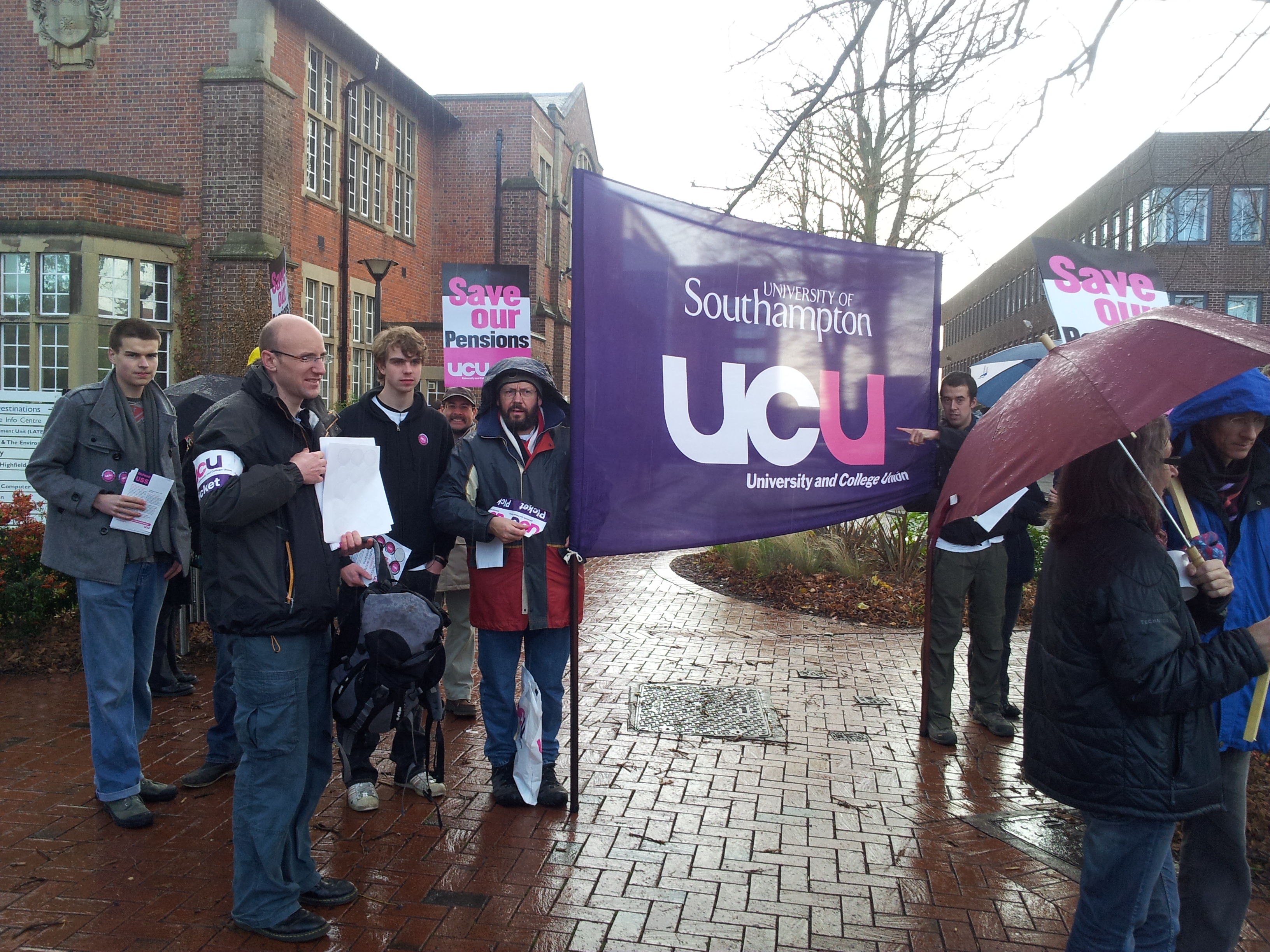
Southampton UCU started it’s day of action early, braving the cold and drizzle to set up our pickets at the Highfield Campus of the University of Southampton.


Soon we were joined by a group of supportive students (the banner reads ‘Workers and Students United’) outside the UCU office, where we refueled, warmed our frozen feet and prepared to march into town….


On the way we saw a striking message left on the Physics building…


And then we marched 100-strong into the city centre, where we prepared to join our colleagues in our sister unions in a march to the rally at Guildhall Square.


UCU had a strong presence in the march, featuring our own large contingent along with colleagues from Southampton City College, Eastleigh College and Southampton Solent.


The march through the city centre was abuzz with energy, as passers-by stopped to wave, shout their support and take pictures.


Finally we arrived at Guildhall Square, where the massive crowd was treated to speeches from representatives of unions from across Southampton and south-west Hampshire, including our very own Professor Catherine Pope.  The gathering was boisterous and enthusiastic, but always peaceful, and filled with optimism.  Hopefully a sign of things to come!

All told the day of action was a smashing success.  We were thrilled at the turnout for the march into town, and our pickets were strong and well-received: we were visited by Vice-Chancellor Don Nutbeam (who later sent us free coffee and tea!), Director of Human Resources Janice Donaldson, Registrar Tessa Harrison, and Provost and Deputy Vice-Chancellor Adam Wheeler.  Everyone engaged us in civil and spirited debate, and expressed their appreciation for our conduct during this industrial action, and we are grateful to them for stopping by and talking with us.

Southampton UCU would like to thank all members who came out to picket and march today, and we would especially like to thank the students who joined us on the march, showed their support all day, and distributed our flyers all around the campus beyond where our pickets could reach — you were all fantastic, and your support means a great deal to us.

A great day without a doubt, both for Southampton and for the country as a whole.  Let’s keep the momentum going!

—–

Eric Silverman


30 November – A statement from the branch President

Tomorrow is going to be quite a day.  A day of action featuring several million people.  A show of solidarity and strength by more than 20 trade unions, including our own.  A demonstration of our collective unwillingness to sit back and watch our benefits get taken away without negotiation.

But more than that, it’s a chance for us to show that we’re prepared to fight back.  To step up when our employers, and this government, decide that they can take away what we have worked so hard for.  To stand in the way of changes done for reasons of ideology rather than need.  To show to our colleagues, our students, and our community that we stand prepared to defend higher education in this country.

The USS pension scheme is the second-largest pension scheme in the country, and is cited as one of the most financially stable.  Even during the current crisis, the scheme is not in terrible danger of falling apart.  And yet, our employers have chosen to attack the scheme, to replace it with a markedly inferior two-tier structure that is unfair to new members, and to increase our contributions while making sure we get less out of it.

Some members have expressed to me the view that, while these changes are a disaster, we should be thankful for keeping a decent pension in the current climate — so why are we getting all fired up? But of course, these changes aren’t happening in isolation; they’re happening in concert with other sweeping changes to higher education that, when combined with the pensions issue, threaten our profession and our universities.  On top of our lesser benefits, our universities are getting their funding cut enormously, meaning we have to deliver more with less money.  Support has been cut for poor students who need financial support to attend college.  University students are now expected to pay triple the amount of fees as before and live the rest of their lives with a mountain of debt.  Along with all of this, lurking ominously in the background has been the promise of changes to university certification, which will allow private education providers — and the predatory lenders who come with them, as we’ve seen in the United States — to enter the sector and change the landscape of higher education forever.

For me, I feel like I know where this path ends.  I come from the United States.  I have $118,000 in student loan debt, which will follow me for the rest of my life and is not dischargable for any reason, including bankruptcy.  I’ve seen the undercover investigations of private education providers, and how they prey on the poor, the mentally ill, the infirm, offering them a chance at ‘education’ but in the end providing only empty promises and a lifetime of debt servitude.  Finally, I’ve seen what happens when unions are broken and when benefits are eroded: workers certainly don’t end up with a ‘good enough’ pension that is protected.  Eventually, as soon as the employers can engineer it, those benefits disappear entirely.  And they don’t come back.

Tomorrow will be a fantastic day, filled with inspiring rallies, glorious marches, and comraderie and solidarity.  But it will also be an opportunity for us to say that enough is enough.  That we don’t want a higher-education sector funded on the backs of students, a sector that preys on its workers and denies them the right to a dignified retirement after many years of hard work.  We deserve better than that.  Our students and co-workers deserve better than that.  Our society deserves better than that.

Please stand with us on 30 November.  Let your employers know you’ve had enough.  The challenges ahead require unity and strength; and the more of us there are, the stronger we are!

————-

Eric Silverman, PhD

Southampton UCU President

Day of Action — 30 November

Wednesday 30 November: UCU members at the University of Southampton will be taking strike action in defence of USS pensions!

We urge you to support this action by JOINING OUR OFFICIAL PICKET LINES and NOT COMING TO WORK.   UCU members will be picketing near the entrances to a number of workplaces covering a range of campuses.  We are seeking volunteers on a rota basis to cover short periods of time.  Please email ucu@soton.ac.uk if you are able to help with this.

At 11.15am we will regroup outside Union House (47 University Road) to march into town, via Avenue campus, to Hoglands Park.  There we will join colleagues from our sister unions (Unison, Unite, ATL, PCS, NAPO, NUT, Prospect, NASUWT) on a march through Southampton centre to Guildhall Square for a rally starting at 12.30pm.  There will be speakers from all of these unions addressing the rally, including Southampton UCU.

The University has been informed that UCU will be taking industrial action. You DO NOT have to inform, in advance, your manager or the university that you will be taking industrial action, but if asked afterwards you must answer truthfully.  For those of you who have students, as a courtesy you may wish to inform them about your participation in this action and explain your reasons for participating.

It is likely that you will lose a day’s salary for taking part.  If you are for some reason unable to strike but wish to support the action, please contact the UCU office for advice — and please DO NOT cover for striking colleagues.

As a UCU member we would ask you to support the action by:

1)   Not coming to work on 30 November

2)   Letting us know if you are able to join a picket line

3)   Joining us at 11.15am on the march into town

See you on the picket lines!