Why Women Don’t Want to Work Here

The recent publication of the results of a longitudinal study of PhD students in chemistry in the UK (in PDF form here) has received a lot of attention in the press. The figures look bad, and highlight the enormous gender gap that persists in higher education; by the third year of PhD studies, the percentage of male students who wished to continue on an academic career path dropped from 61% to 59% — but for women, the drop is from 72% to 37%.

Curt Rice writing for the Guardian asks the all-important questions “How can it be this bad? Why are universities such unattractive workplaces?” The possible answers to this are many and varied, of course, but the report shows that many women are deterred by the ‘macho’, competitive and solitary nature of the academic life.

Perhaps we need to take a deeper look at our work environment to understand how we ended up where we are. I’m sure many of you would agree that the academic career path has become harder to navigate. The ‘perpetual postdoc’ problem has increased as permanent lectureships or research posts are thin on the ground, and talented researchers are pushed out of academia as they seek to avoid casualised insecure employment (perhaps because they wish to start a family or buy a home). The long-hours culture also takes its toll and makes our profession less attractive to many. All these pressures have a disproportionate impact on female colleagues.

Instead of addressing these inequalities university managers focus on such things as getting us higher up the university rankings or obtaining ever-larger research grants. In this context, the current hiring practices of universities make a lot more sense: they are driven by a need to make tables of arbitrary numbers go up (in league tables, departmental rankings, and finance reports), and the human cost is invisible or secondary.

At this University the decision to focus on achieving a top 50 world ranking (discussed in my previous blog post) has produced hiring practices directed at snatching up ‘research leaders’, rather than developing our own staff and offering them opportunities to shine.

UCU are pushing for improvements in the working environment at this institution. We have held informative workshops, created a Fixed-Term Contracts Working Group, pushed for  negotiation on the Academic Reward and Recognition project, and sought your input and feedback. But on a broader level, we face challenges extend far beyond the borders of this  institution. We have an academic culture now so focused on short-term goals and externally imposed metrics that it is tearing itself apart. Gender inequalities are just part of the evidence for this; clearly our institution fails to attend to the barriers facing women here. But we are also so pushed to seek grant funding that we give no time to the plight of postdocs on casualised contracts who we fail to develop and who have little hope of advancement or job security.

We need a work environment and culture that develops and nourishes its staff, and supports enthusiasm, intellectual vitality and academic freedom. Instead we often offer a workplace which forces all of its members to give up their lives and families to focus on short-term goals. This promotes gender inequality and produces an exploited academic underclass. We know why women can’t and don’t want to work in these environments. We know it is not good for them or anyone. Isn’t it time we did something about this?

——-

Eric Silverman (President) and Catherine Pope (Equalities Officer)


What’s Wrong With DAP?

We’ve been touring the University with our DAP-Alternative roadshow to try to gauge UCU member responses as well as soliciting feedback from staff who might not yet be union members (the meetings were open to all University of Southampton staff) on the proposals to introduce a new ‘reward and recognition’ policy or DAP (Development and Appraisal Process) as it is otherwise known.

Our Provost, Adam Wheeler, and Director of HR, Janice Donaldson, had a series of open meetings to explain their proposals for a new matrix model that they want to use to ‘manage up performance’. Whist these meetings were not part of the formal consultation process (which has to be conducted via UCU as the recognised trades union) they were useful as a briefing about the new plans.

I think it’s probably fair to say that Adam and Janice have been surprised by some of the negative reaction to the DAP ideas. Things came to a head in March when, in response to members concerns and our own concern about the failure to consult the recognised Trades Unions about this important and significant proposed change to our terms and conditions, we called an Emergency Joint Negotiating Committee (JNC) to talk to senior managers about DAP. As a result of this meeting the senior management agreed that they would consult with the recognised trades union on this matter and a series of meetings between UCU reps and senior management began on 21 May.

At our UCU general meeting on 28 March we received overwhelming support for a proposal that we should ask our management to halt the DAP project. We put this to Adam and Janice at the meeting on 21st May along with summaries of the earlier feedback we have received.

Our series of meetings at WSA, Highfield, Waterfront, SGH and Avenue gave you the opportunity to air your concerns about the proposals. I thought I would take some space on the blog to describe in-depth three of the concerns expressed by staff at these meetings and in some of the correspondence we have received from members on this issue.

Why don’t they just fix PPDR (the existing performance and development process)?

This theme turned into something of a mantra in our discussions with staff. Rather plaintively you just kept saying ‘why do we have to have yet another new system?’ and perhaps more perceptively ‘what makes them think anyone will do this new system when we failed so abysmally to get buy in for PPDR?’ We gathered stories of staff who had not had a review for 5 years, or had been told they were too junior or senior to need one, and of others who had perfunctory PPDR which began with a heartwarming ‘Let’s get this over with for another year’ and ended with the crunch of the filing cabinet as ‘the form’ disappeared never to be seen again. In contrast there were also some good examples of PPDR working positively – managers who regularly review progress and staff development, work together with staff to set achievable expectations, try to address workload problems overload and seek to create environments where staff can succeed.

We don’t want performance related pay

There continues to be opposition to the increased use of performance related pay. One manager at our meetings said he categorically did not want to be in the position of deciding people’s salaries as he felt that would damage research and teaching teams. The University already has some flexibility to offer enhanced increments, to recognise higher responsibility and pay market supplements to attract staff. Managers can also withhold the annual increment if performance is deemed unsatisfactory. While pay is increasingly important in this economic downturn it is not the only thing that motivates our staff: we are typically motivated more by our science; our research; interacting with students, and so on. Many staff report that their workloads are now too high and are having a detrimental impact on their lives or health and – understandably – they would prefer this problem was addressed before paying a few selected individuals a little more.

Rejection of more complex change

One of the most overwhelming responses from staff as we toured the University was that this was yet more change at a time when everyone is already struggling to adapt to the radically new structures and reduced administrative support. Staff were unconvinced by the 9 matrix which they felt did not address the problems with the promotion system and introduced unhelpful additional layers within existing grade levels. They were worried that unreliable, unvalidated, and subjective measures of performance would be introduced. Staff in the meetings and in correspondence with us report that there continues to be a problem with bullying in the University and that promotion appeared to be dependent on patronage rather than merit in some cases. They were anxious that the proposed DAP system might exacerbate this. The key issue for staff centred on being valued. Many felt that the culture of the University and some of the ‘messages from the top’ (the hundred heavy hitters policy was one frequently mentioned, and the idea that everyone needed to be ‘over capacity’ in the early DAP diagram was another) devalued their contribution. They felt that management practices tended to be disciplinary rather than developmental, and that performance management was based on punishments/sticks rather than incentives/carrots.

WHAT NEXT?

We’ve had our first meeting with Adam and Janice yesterday and discussed how we might take this negotiation forward. Adam and Janice have prepared a revised version of the DAP proposals which is currently with the Vice Chancellor and this will go to the University Executive on 29th May. After that UCU will be asked to comment on the proposals and we will be using all the comments you have given us to prepare this response. We have a series of working party meetings scheduled with Janice and Adam and will continue to use our Joint Negotiating Committee to represent staff on this issue. We are grateful to the members who have volunteered to help us with this and will be involving them in the negotiations alongside the executive group. As ever we welcome your comments and views about the DAP proposals so please do keep sending them in.

A personal reflection

One of the things that strikes me about the debate around DAP and performance review is that most staff are in complete agreement with the goal of these processes – in the meetings this was often phrased as ‘of course we want the university to succeed’ or ‘we understand that there are targets that we have to do well against’. (There was much less consensus about the feasibility of getting into the top 50 world ranking (see Eric’s previous blog post about this), but staff genuinely want to do a good job – whatever their level and role). What makes me sad and frustrated is the fact that there continue to be places in this University where staff are not supported to deliver success.

We continue to fail to develop the talents of all our staff. In part this is because of casualization – the regular ‘dismissal’ of some 200 fixed term contract staff means there is little inbuilt incentive to develop a significant proportion of our colleagues. We appear to spend far less on training and development than many comparable institutions (we no longer have a member of staff devoted to developing Early Career researchers and delivering the Research Concordat, for example). Continual change has often had a negative impact on culture and morale – staff feel that they are not valued and their views about the negative effects of reorganisation are not heard. We have broken up the academic team – by separating our professional services and academic roles such that it is increasingly difficult to work effectively in teams, and many of the technologies introduced to replace staff (banner, agresso, managed print) have displaced work rather than reducing workloads as promised. We have failed to share good management practice and remained silent about poor management and the reasons for it.

The University has significant problems with promotion processes and valuing its staff. We know that there is a gender bias in promotion and this perpetuates the gender pay gap (and wastes talent). We do not adequately develop and support our staff to deliver their best. In some places we manage performance well but this is not consistent or universal — we need to improve. A good PPDR system – backed up by supported and well trained managers/appraisers – could address these problems. As someone who has had, and has benefited from, positive and supportive management I know this is possible with the existing PPDR system. Rather than investing in a new DAP system we could channel resources into training and developing our staff, and encouraging positive people management.

We might also want to reframe the questions we ask – what if instead of being in the top 50 our aspiration at University of Southampton was to be the best place to work?

——-

Catherine Pope

UCU Executive Committee

The Top-50: Is This A Place Southampton Wants To Be?

As our members are probably aware, the University has set a strategic goal of achieving a spot in the top 50 in the world university rankings.  On the face of it, this seems an admirable goal; after all, who wouldn’t want our University to be recognised worldwide as a top-notch place to learn and to do research?

However, when we take a closer look, we begin to see how ludicrous this goal would be for our institution.  For comparison, let’s examine Penn State University, currently sitting at 51 in the rankings (just below Brown University and Peking University, which are tied for 49th).  Penn State — which also happens to be my undergraduate alma mater — currently sits on an endowment of $1.52 billion (about £955 million), with net assets of $8.73 billion as of 2010 (about £5.48 billion; Southampton’s net assets last year totalled £330 million by comparison).  Their operating budget last year was over $4.1 billion (approximately £2.56 billion).  Penn State’s research income last year was $780 million (£490 million; compare to Southampton at £93.6 million).  On top of this, the main University Park campus of Penn State has 44,000 students (compared to 23,000 at Southampton); but when you include the other 23 Penn State campuses, the total reaches around 95,000.

So, at number 51 on the rankings, we have an institution dealing in budget numbers far beyond the reach of this institution, educating
nearly four times the number of students, and earning more than 5 times as much research income.  Is this something we can compete with?  Moreover, is this something we *want* to compete with?

I’d argue that we absolutely do not want to get sucked into this kind of competition.  The further we look up the rankings, the worse the
numbers get (Harvard has an endowment of $32 billion, or just over £20 billion!).  There is every indication that these rankings are based upon these silly number games, and very little evidence that they provide any useful information to students looking for a place to study.  Meanwhile, there are institutions that do very well for themselves while abstaining from these prestige competitions entirely.

One of the more notable of these is St John’s College in Annapolis and Santa Fe, which has a remarkable letter on its website from its
presidents (http://www.stjohnscollege.edu/about/rankings.shtml) discussing why they have chosen to abstain entirely from the US News and World Report Rankings.  Here’s a small sample:

“Over the years, St. John’s College has been ranked everywhere from the third tier, to the second, to the first, to the “Top 25” among
national liberal arts colleges. Yet we haven’t changed. Our mission and our methods have been virtually constant for almost 60 years. We would rather be ourselves and have our college speak for itself, than be a part of this fluctuating outside analysis. The distinctiveness of each individual college and the diversity among them tend to be lost in a scale of “best-good-worse.” Research university or small liberal arts college? Religious affiliation or pre-professional training? Core curriculum or a multitude of majors? America’s colleges offer all of these. A college that is exactly right for a particular student– in its mission, mode of teaching, location, moral or religious
character– might receive a lower rank in the survey than a college which would not suit the needs of that student.”

I’d argue that this is the problem with university rankings: they attempt to quantify an experience that, by its very nature, is different for every student.  Our placement on an arbitrary table, decided by constantly-changing criteria, is not an adequate measure of the incredible variety and diversity present at this institution. Even if we were to reach the heady heights of the Top 50, there is still no guarantee that the following year would not see us displaced — and not due to a fall in research outputs, or student survey numbers, but simply due to a small change in the ranking criteria.

Where we certainly can, and should, compete however is in the area of the student experience.  This is an area where Penn State also excels and has excelled for many years.  Penn State has an alumni association  with 500,000 members or so, the largest in the world, and out of those, more than 160,000 pay dues every year to be a part of that association.  Think about it — 160,000 people paying money to the university, every year, simply to retain an association with their alma mater, to get a newsletter, and maybe a discount on football tickets.

Dedication and pride like that doesn’t come from arbitrary and constantly-fluctuating ranking positions.  It comes from having a fantastic student environment, top facilities, excellent teaching, and efforts to build a community that fosters cohesion, trust, and student identity.  These are all areas where Southampton absolutely *can* compete.  We can develop this institution into a nourishing and edifying community for our students — a place that remains with them, even when they go off to other institutions or into the workforce. These things do not require budgets in the billions to accomplish — they require dedication, support for our facilities and our staff, and the creation of an environment that fosters learning and a sense of community.

I worry that the focus on rankings takes us away from focusing on things that can truly bring character and reputation to our university.  They make us focus on budgets, surpluses and ‘economic impact’, rather than student satisfaction, staff development and retention, and community support and cohesion.  Rankings may bring us applause from University Deans, Presidents and Vice-Chancellors, but what brings the same from students are other things entirely. Likewise, creating a dynamic and challenging learning environment for students rests on giving our teaching staff the support and development opportunities they need to give every lecture their full attention, instead of being forced to worry about rankings, research output requirements, promotion panels and inter-departmental politicking (all things that an all-encompassing focus on numbers and rankings exacerbates).

Don’t get me wrong — I don’t want to suggest that we turn ourselves into Penn State, Hampshire Campus.  Not to mention that, as recent events have shown, Penn State is not immune to rankings fever — as evidenced by the disgraceful behaviour of their football coaches and related members of staff who sacrificed even their basic morality to push that football programme to the top.  But I do think the comparison is illuminating.  As a student at Penn State, I never knew nor cared what our ranking was — nor, I suspect, do the overwhelming majority of students at Southampton.  What I cared about, and what our students care about, is what they experience day-to-day: how their learning is supported and nourished; how their facilities look and feel; what sort of opportunities they have to make friends, foster relationships and build connections for the future; and the enthusiasm and dynamism of their lecturers.

This University is blessed with a energetic and diverse student body and fantastic teachers and researchers, all of whom want this institution to grow and be recognised.  So let’s work together to build that recognition in a real, sustainable way — one built on making this a supportive and inclusive environment for learning and discovery.  If we do that, top-flight students and staff will come here in droves and continue to do so — regardless of what the rankings say.

——-

Eric Silverman

Southampton UCU President

Southampton UCU Spring Seminar Series

Southampton UCU together with the Union Cities Project are pleased to announce that we are launching a Seminar Series this spring.  These public talks are intended to give University of Southampton staff a window into some of the broader issues being discussed in academia today, and to provide a forum for free and open discussion.


Our first two confirmed seminars are listed below, and we encourage all interested parties — members and non-members alike — to join the discussion.


Tuesday 28 February 4pm — Room 32/3077


Richard Murphy

“Tax, Justice and the State”

We are delighted that Richard Murphy has agreed to talk to us and hope this seminar will provoke lively discussion and debate about the relationship between tax policies, the economic situation, cuts to public services and Higher Education.

About the speaker:
Richard Murphy is a chartered accountant and economist. He has been described by the Guardian as an “anti-poverty campaigner and tax expert”. Richard was founder of the Tax Justice Network and is director of Tax Research LLP which undertakes work on taxation policy, advocacy and research for aid agencies, unions, NGOs and others in the UK and abroad. He is a University of Southampton graduate and his most recent book is the Courageous State: rethinking economics, society and the role of government.


Tuesday 3 April 2012 4PM – Room 32/3077


Dr Paulina Trevena

Research Fellow, ESRC Centre for Population Change


Exploring mechanisms for the retention of Early Carer Researchers at the University of Southampton.


A critical step in a researcher’s career is the transition from a postdoctoral post into a more permanent research position. Fellowships from the major funding bodies designed to ease these early career researchers (ECR) into their first independent position are scant and hugely oversubscribed. University lectureships also rarely become available, and receive many applicants. The general lack of adequate systems for retaining talented ECRs in higher education and the associated costs of research staff turnover have already been highlighted nationally. The ‘Concordat to Support the Career Development of Researchers’ states that ‘organisational systems must be capable of supporting continuity of employment for researchers, such as funding between grants, other schemes for supporting time between funding, or systems for redeploying researchers within organisations where resources allow.’ In this presentation we’d like to discuss the results of a small-scale project on retaining ECRs at the University of Southampton (UoS). As part of the project, we  explored the views, experiences and needs of UoS ECRs with regard to retention mechanisms, and examined existing retention mechanisms at our University as compared to other UK universities. On this basis, we have made recommendations for introducing certain ECR retention mechanisms at UoS.

——-

Eric Silverman
Southampton UCU President
Tying pay to performance does not work!

As members may be aware, UCU has long stood against the introduction of performance-related pay in UK higher education.  We take this position due to the inherent nature of academic work, which requires long-term vision, patience, and the gradual development of expertise and knowledge — clearly not a match for performance-related pay policies, which encourage short-term gains above all else.

In the current climate, the University of Southampton is proposing the introduction of a new Academic Reward Strategy which threatens to bring related measures into our workplace.  We stand strongly against this move, and will continue to express to the University our opposition to performance-related pay — and the critical importance of non-monetary rewards in any proposed academic reward strategy.

Even in the business world, performance-related pay is a risky venture, and evidence continues to mount that such polices simply do not work.  Employees are encouraged by such policies to seek increased pay as the motivation for doing well in the workplace, rather than any intrinsic motivation.  In the pursuit of such monetary incentives, employees may begin to take risky paths to achieve the required short-term gains.

In fact, non-monetary rewards seem much more effective.  In the case of academia, we expect that many of our members might prefer additional research time, more administrative support, or other similar things much more than a simple bump in salary.  Over the long term, such rewards are much more likely to create better working environments and better research as a result — and in turn, make employees feel more valued for their intellectual prowess.

The link below presents an article* in the Harvard Business Review which summarises the problems with performance-related pay policies — problems which are overwhelming supported by the relevant research literature:


http://hbr.org/2012/01/tackling-business-problems/ar/1


We encourage all our members to tell the University not to introduce performance-related pay measures into our workplace.  Performance-related pay is already known to be bad for business — and the short-termism encouraged by such measures would be even more disastrous in an academic environment.

——-

Eric Silverman

Southampton UCU President

*Many thanks to Moray McAulay for the link.

What Are You Worth? The University’s Proposed Pay and Reward Plans

UCU members have already been alerted about the University’s proposed new Academic Reward and Recognition strategy. Details of the proposals can be found at https://sharepoint.soton.ac.uk/sites/arr/default.aspx

When this topic was first raised by Human Resources last year your branch executive were extremely keen to talk about how staff might best be rewarded for all their efforts. Having gone through yet another massive organisational change and stripped administrative and support staff to the bone, and somehow delivered on increased income, high quality teaching and research despite this, we hoped this would be a chance to suggest how the University could show its appreciation for its staff.

However it has become clear that – rather than focusing on the important issue of valuing and recognising staff contribution and effort – these proposals represent an extension of performance management and significant changes to agreed academic roles.

Southampton UCU are very concerned about these proposals. Responding to your feedback we summarise the key issues here:

Much of the thinking behind the proposals is based on the performance and potential matrix – often referred to as “the nine box”.  While certainly a popular way of ‘assessing talent’ this model of Human Resource management it is hotly debated and disputed. (It is worth noting that it closely resembles the asset stripping approach used by the GE–McKinsey to “prioritize its investments among its business units” http://kenhoma.wordpress.com/2011/10/26/.)

The proposals threaten a number of important features of the current pay framework which UCU members will remember fighting for in 2004. First they remove incremental progression. Currently staff progress to the next pay point on the basis of satisfactory performance. This continues until staff reach the top of their pay level or move into the Higher Responsibility Zone (HRZ). While incremental progression is not automatic – increments can be withheld if performance is deemed unsatisfactory – most staff welcome this financial recognition of their continued performance (especially at a time when inflation is running at 5%). Southampton UCU believes that our members want to keep incremental progression.

The proposals, as they stand, potentially break up the job families – by introducing levels of competency within each level the model is effectively splitting each grade. Instead of 7 levels we would have 21- each with pay ceilings and restrictions on progression. Already Human Resources are considering introducing an ‘apprentice academic’ grade which would break the minimum pay point for academic  (ERE) lecturers and would allow the University to employ ‘lecturers’ on lower pay than agreed in 2004. Such an alteration to the job families and levels breaks the nationally agreed pay framework and would effectively mean that Southampton would be forced into protracted, time-wasting local pay negotiations and possibly continual local disputes over pay and grading. (Your UCU executive are perhaps understandably concerned about the burden on local UCU activists and the likely reduction in volunteer members available to undertake casework and protecting other rights for our members).

Given the high volume of casework presently undertaken by Southampton UCU related to harassment and bullying of staff by managers we are anxious that the proposals give considerably more power to line managers, and  open up further opportunities for subjective assessment of  performance and potential victimisation of staff. Alongside this there is a threat to academic freedom as line managers will have control over what is regarded as competent performance, and are free to proscribe certain research topics or activities as they set expectations.

Finally we are concerned that all too often Human Resources and the Senior Management of the University – perhaps because of their own financial position – see wages and promotion as the only motivators for performance.  In our discussions with our members many of them tell us that while they might make more money working in the private sector they have deliberately forgone financial rewards because they want to transmit and develop knowledge and to share expertise with the next generation and fellow researchers. This public service ethos stands in stark contrast to the ‘business models’ currently driving much of the University strategy. Perhaps this is why – during the mass voluntary redundancy exercise of summer 2011 – many of our members commented that rather than seeking personal pay rises they would prefer to keep academic and administrative colleagues in post to deliver teaching and research effectively in the University.  In addition the proposed model assumes that everyone should always be aiming to move up to the next level. We feel that this undermines diversity and flexibility policies and may prevent some from achieving work-life balance – and it also ignores the possibility that highly talented, well-performing staff members might be happy to continue to deliver excellence at a certain level/grade without the desire or expectation to move up and thus increase their responsibility/workload/hours.

We are concerned that like many schemes in the University these proposals are being pushed through too fast with inadequate consultation and negotiation. Following discussions with regional and national UCU officials we have told the University that we are concerned that the University does not appear to be complying with our recognition agreement that matters of pay and reward are subject to negotiation with UCU, and that under our agreements UCU is the “sole representative agency” for such discussions.  We have asked that the Provost and /or Director of HR commence proper negotiations with on the new academic reward and recognition proposals.

As ever – if we are to effectively represent your views – we need your comments and concerns – so please email ucu@soton.ac.uk with your thoughts about the proposed changes to your pay and terms and conditions.


——-

Professor Catherine Pope

Southampton UCU

Invitation to Southampton and Eastleigh Question Time Event

Invitation to Southampton and Eastleigh Question Time

January 20, 2012 at 6:00 pm

Southampton City College 


The University and College Union (UCU) would like to invite you to a special Southampton and Eastleigh Question Time on January 20 2012, which is being organised by UCU and will be chaired by BBC South’s political editor Peter Henley.


A panel of MPs, business leaders and educators will take questions from the audience and discuss how Southampton and Eastleigh can prosper in the current economic climate.   Education, employment, skills, business and opportunities for young people will be some of the key issues debated during the evening


The guest panel will be:


§  Rt Hon Chris Huhne MP – MP for Eastleigh and Secretary of State for Energy and Climate Change

§  Rt Hon John Denham MP –  MP for Southampton Itchen and former Secretary of State for Innovation, Universities and Skills

§  Lawrie McMenemy – former manager of Southampton FC

§  Jan Ward – Chief executive of Southampton based Corrotherm International and Southampton & Fareham Chamber of Commerce & Industry

§  Julie Greer – Head Teacher of Cherbourg Primary School, Eastleigh


Audience members are asked to arrive for 6:00pm. The event will begin at 6:15pm promptly and will last for approximately one hour.  Attendees will be given the chance to submit questions for the panel.   There will be a small reception and chance to chat to fellow audience members and panellists after the event.


If you are interested in attending and would like a ticket, or to submit a question, please RSVP to Lisa Johnson at ljohnson@ucu.org.uk As we only have a limited number of places available tickets will be allocated on a first come first served basis.  PLEASE ALSO NOTE THAT ENTRY TO THIS EVENT IS BY TICKET ONLY.

UCU Union Cities Christmas Party – 14 December

Please Join Us for our UCU Union Cities

 Party and prize-giving!


Date: Wednesday 14 December 2011

Time: 5.30–11pm

Venue: The Studio Café Bar, Nuffield Theatre,

University of Southampton

Highfield Campus, University Road

Southampton, SO17 1TR


Please join us for a drink, a dance, a bite to eat and

find out who has won the £100 Union Cities survey

prize!


Free parking on site after 6pm


Free child care places will available in the fully

staffed, university nursery from 6.30–9pm.

Members will get first refusal on places should they

become limited.


To book a place in the crèche please

contact kbrooks@ucu.org.uk


Stay up to date with the union cities project on

Twitter:@unioncitysoton and check out our

Facebook page: http://on.fb.me/uDtBry

Researcher’s Workshop: Great attendance and great feedback!

Southampton UCU held a Researcher’s Workshop today, intended to provide early-career researchers at the University with detailed information about their rights, the national campaigns focusing on researchers and issues related to fixed-term contracts, as well as current local campaigns around these concerns.

The workshop was very well-attended, with 30 researchers from a variety of faculties attending to discuss their rights and their current situations.  Ronnie Kershaw on the UCU National Campaigns Team ran the proceedings, and Andrew Currie from the Regional Office provided detailed and useful background about the national picture.  Dr Stephen Tarling of the University of Southampton Professional Development Unit gave an excellent summary of opportunities available at the University for career development and training.  Eric Silverman, Southampton UCU President, also ran an interactive session in which attendees gave us some very valuable guidance about where we should focus our energies in future negotiation.

Overall the workshop was an excellent, informative afternoon… but we mustn’t stop there!  Southampton UCU still needs your feedback.  What has been your experience of being an early-career researcher?  What problems have you faced in terms of poor management, job insecurity or career development?  How could Southampton UCU help you, and further, would you like the opportunity to get involved more directly in our campaigns on fixed-term contract issues and early-career researchers?

So please, email us and send us your ideas and feedback!  We’re doing our best to take these issues forward, and your input is extremely valuable in making sure that we focus on the right issues and progress in a way that best benefits our membership.

30 November – A fantastic day of solidarity in Southampton

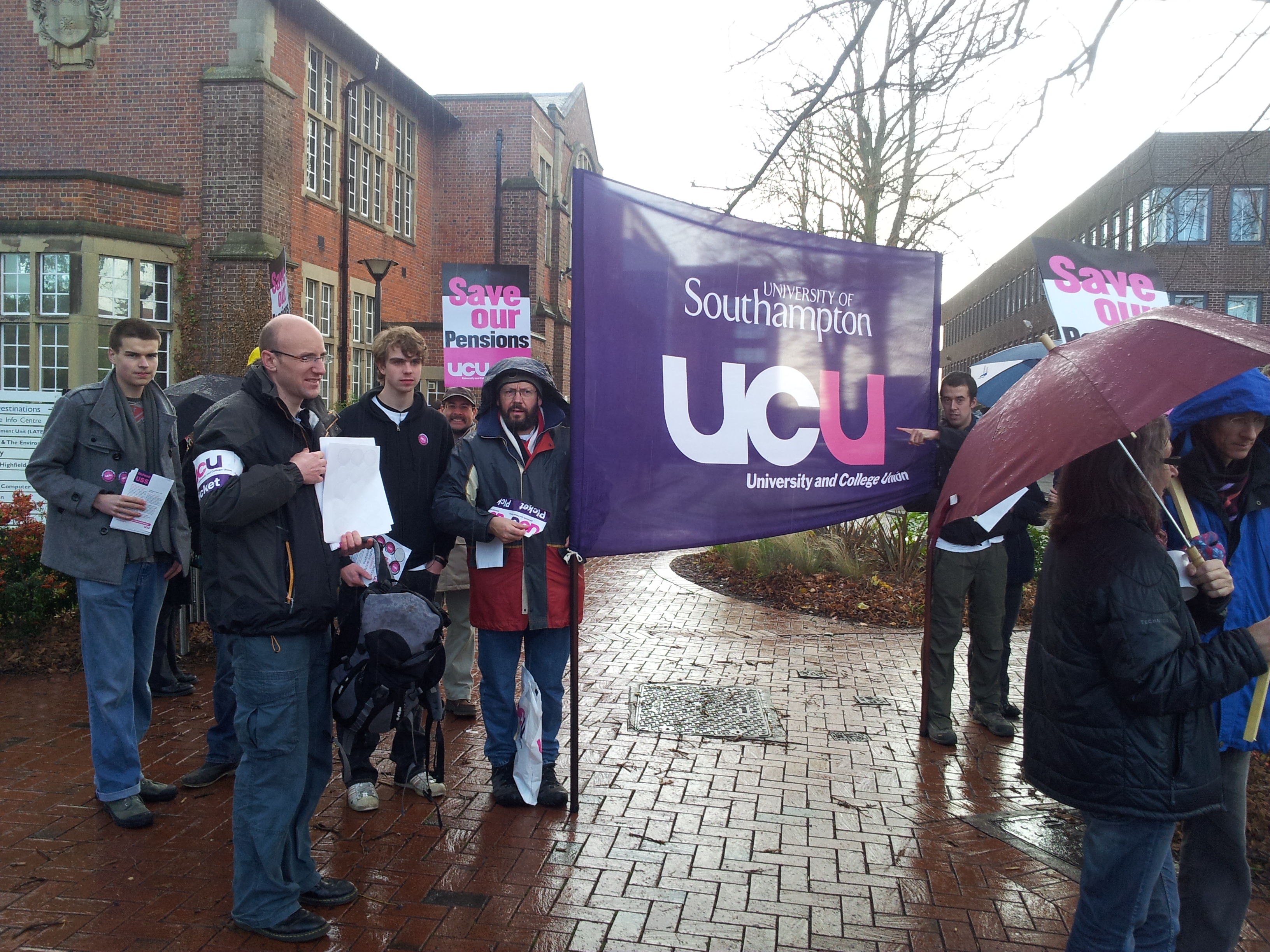
Southampton UCU started it’s day of action early, braving the cold and drizzle to set up our pickets at the Highfield Campus of the University of Southampton.


Soon we were joined by a group of supportive students (the banner reads ‘Workers and Students United’) outside the UCU office, where we refueled, warmed our frozen feet and prepared to march into town….


On the way we saw a striking message left on the Physics building…


And then we marched 100-strong into the city centre, where we prepared to join our colleagues in our sister unions in a march to the rally at Guildhall Square.


UCU had a strong presence in the march, featuring our own large contingent along with colleagues from Southampton City College, Eastleigh College and Southampton Solent.


The march through the city centre was abuzz with energy, as passers-by stopped to wave, shout their support and take pictures.


Finally we arrived at Guildhall Square, where the massive crowd was treated to speeches from representatives of unions from across Southampton and south-west Hampshire, including our very own Professor Catherine Pope.  The gathering was boisterous and enthusiastic, but always peaceful, and filled with optimism.  Hopefully a sign of things to come!

All told the day of action was a smashing success.  We were thrilled at the turnout for the march into town, and our pickets were strong and well-received: we were visited by Vice-Chancellor Don Nutbeam (who later sent us free coffee and tea!), Director of Human Resources Janice Donaldson, Registrar Tessa Harrison, and Provost and Deputy Vice-Chancellor Adam Wheeler.  Everyone engaged us in civil and spirited debate, and expressed their appreciation for our conduct during this industrial action, and we are grateful to them for stopping by and talking with us.

Southampton UCU would like to thank all members who came out to picket and march today, and we would especially like to thank the students who joined us on the march, showed their support all day, and distributed our flyers all around the campus beyond where our pickets could reach — you were all fantastic, and your support means a great deal to us.

A great day without a doubt, both for Southampton and for the country as a whole.  Let’s keep the momentum going!

—–

Eric Silverman