Don’t turn back time: women and the cuts – 19 November 2011

This is an edited version of a talk given by Catherine Pope, Southampton UCU Equalities Rep to the Southampton Feminist Society and Socialist Society event for the Fawcett Campaign to ask the government ‘Don’t turn back time on women’s equality’ on 19th November.

I am a Feminist. I am also a Mother (to three boys aged between 9 and 20). I am a Professor at the University of Southampton – so I am variously a scientist /academic / educator / researcher. If you want specifics, I am a sociologist who studies health care organisations and teaches health professionals and a Web Scientist studying the world wide web and co-directing a major doctoral training programme here at the University.
I am also a Trade Unionist. I have been member of UCU (University and College Union) since its creation and before that of the Association of University Teachers – its predecessor – since the late 1980s. I am currently the Equalities Officer for the local branch and region. I am an activist. I haven’t always been one but I find, contrary to the usual political trajectory, which has people tending to get more conservative with increasing age, I am becoming more radical as I get older. (I am 45 now so goodness only knows what I’ll be like when I’m 80 if I go on like this). I have become more radical and I have been radicalised. In my 20s my activism was focussed on the peace movement – marching with CND, and of course, as a student in London the 1980s, defending free education and fighting for the Greater London Council. Over recent months I have become closely involved with the anti-cuts movement – notably UK Uncut. In fact this week I have been supporting some inspirational people involved in the UK uncut non-violent action in Fortnum and Mason’s earlier this year. I am, and continue to be, passionate about defending education – particularly post-16 education: that is higher education in Universities like this one and further education for 16-19 year olds in our colleges, and other forgotten areas such as adult education, prison education.
Of all the labels I might use for myself, Feminist is the most important. Without it I would not be here. I do not think I could have achieved any of the other things without Feminism and importantly I could not have done it without Feminists. (and I must be clear that I do not only mean women, though many women have been important to me on this journey. I include here the numerous men who have supported and inspired me.)
The Fawcett Society has a vision “of a society where women and our rights and freedoms are equally valued and respected and where we have equal power and influence in shaping our own lives and our wider world.”

So I’d like to talk briefly about three ‘equal’ rights. Firstly, as we are in here in the University, I thought I would talk about the right to education. I have had a life changing educational experiences, notably at Lewisham College and North East London Polytechnic (now University of East London) where I first studied sociology and learned to think differently about the world. I learned to question why things are the way they are. I learned to see gender and roles as socially constructed rather than given, to see that inequality is often manmade. Had I been born 100 years earlier I would not have had the chance to access education. I was the first in my family to study for a degree. In 1878 the first London university admitted women to its degrees, and even for a long time after that women were still expected to be wives and mothers, not doctors or geographers or lawyers. Women’s access to education was not given to them. It was won in a long political struggle. A political struggle which some of our sisters across the world have not won. According to a United Nations report women in two out of three countries in the world have unequal access to primary and secondary education. For every 100 boys not attending school, there are still 117 girls in the same situation.
I had a free education. I did not have to pay the kinds of fees currently expected from students and I did not leave higher education with the kind of debt facing many of the young women who will study here in coming years. UK students starting university in 2012 are likely to graduate with debts of well over £50,000. Alan Bennett a few years ago said
I believe that all students should have the same access to education as I did. But it just doesn’t happen now because students have to pay for the university tuition their academic achievements have brought them. I don’t claim to know how higher education should be paid for; all I know is that it’s morally wrong to expect students to get into debt”
That sense – that it is morally wrong to charge for higher education – is why I along with many members of my trade union UCU joined the NUS last year for the national demonstration – Fund Our Future: Stop Education Cuts and why we in UCU continue to oppose fees.

Secondly I have grown up with the right to vote. This right was won for me by other women and men who protested and fought and sometimes lay down their lives to win suffrage. Again this right is not shared by all women across the world. And whatever I might feel about the political parties on offer I cherish my vote and use it. Each time I do it is a small repayment of the debt to those that fought for my right to participate in the political process.
The third and final right I want to talk about takes me back my sons. I mentioned earlier that I am a Mum to three boys. They are a delight and amazement to me. I think they might also be feminists like their Dad. As well as being a Mum I also have a career. My choice to have children and work is a choice which the women who came before me could not make. My dear mother in law – the first in her family to go to University, who studied at Oxford and trained as a teacher, left her teaching job when she had her first child. Her own mother had to leave work on marriage. The activists and feminists of the 1960s and 1970s fought for the right of married women and mothers to work, for affordable childcare, family friendly employment policies, and for equal pay and opportunities. It is not easy combining paid employment and parenting. But I have had that choice. That right. And I also have the choice – a personal choice – about controlling my fertility via contraception or abortion. Having children or not. Having a career. Combining the two or not as I choose. These are rights and choices which all women should have – no matter where they live.
I feel privileged that I have had the opportunities I have had. And there is certainly more equality for women in my lifetime than for those in the preceding generations. I have equal rights – to vote and to be educated. I know this gives me a lot more opportunities than many women in the developing world. If I had been asked here just to celebrate feminism and its achievements I would stop there. But I am afraid you will have to listen to me a bit longer. Because I think that the policies of the current government will turn back time on women’s equality. The cuts to public services being made now disproportionately affect women. The Fawcett Society has called the way the cuts affect women a ‘triple jeopardy’ because

1. Women will be hit hardest by job cuts in the public sector
2. Women will be hit hardest as the services and benefits they use more are cut
3. Women will be left ‘filling the gaps’ as state services are withdrawn

Let’s look at some of the ways that the cuts are hitting women.

  • Women’s unemployment is now at its highest in more than 20 years – there are 1m women unemployed.
  • 65% of public sector workers are women; almost a quarter of working women are in public sector jobs so they will be more heavily hit by the public sector pay freeze and the projected 600,000 job losses.
  • Of the nearly £8bn that the government wants to raise by 2014-15, nearly £6bn will be taken from women.
  • Cuts to legal aid of £600m per year for people facing issues relating to divorce, housing, employment, immigration, debt and welfare benefits will hit women hardest, according to the government’s own equality impact assessment.
  • Child benefit has been frozen for the next three years. As 94% of child benefit recipients are women, of the £975m saving from child benefit £913m will be taken from women.
  • The health in pregnancy grant was abolished this April. The Sure Start maternity grant will now only be paid for the first child.
  • Child tax credit changes will cut the income of many families.
  • Changes to state and public sector pensions will disproportionately affect women – who already make up 2/3 of the UK’s poorest pensioners.

Despite a raft of equality legislation women are often treated worse than their male counterparts. Nearly 40 years since the Equal Pay Act women working full time across the UK still earn on average 15.5% than men working full time. According to the 2011 National Management Salary Survey, men continue to be paid more on average than women doing the same jobs (£42,441 compared to £31,895). Despite laws to protect them 30,000 women lost their jobs in 2009 as a result of being pregnant.
This government is doing nothing to address inequality. Their policies are making it worse. The Fawcett Society suggested that we dress up for this tea party in 1950s clothes because today’s event says ‘Don’t turn back time’. Our grandmothers and mothers alive in the 1950s lived with austerity – after WWII. But they could look to the newly created NHS when they were sick and to widening access to free education. They were on a journey that would take them through the women’s liberation and equal opportunities movements that would improve their lot. We’ve come such a long way. Let’s not turn back now.

30 November – Picket lines

We would like to remind all members that picket lines are more than just a way to gather in solidarity with like-minded colleagues — they are a statement, a form of direct action, and a means to disseminate information to other interested parties.  Southampton UCU will provide all pickets with leaflets to distribute to passers-by which summarise the current dispute; if you are picketing, please make every effort to distribute these widely.

Prior to the day of action, you may wish to explain to colleagues our reasons for taking action, and why you feel it is important to take part.  Ask them politely for their support, and if they are eligible to be a member, to pick up an application form and join us!

Remember that you may lawfully attempt to convince passers-by or workers in related industries (such as lorry drivers entering University premises, delivery services, or similar) to support us, and to not cross the picket line!  However, you must do so without making an attempt to deliberately obstruct any individual or vehicle which is attempting to cross the picket line.  You also cannot lawfully obstruct any public highway (for example, roads or paths adjacent to the employer’s property).


There are regulations which specify activities that are and are not permissible when joining a picket line during an official dispute.  DirectGov has a webpage which summarises these:


http://www.direct.gov.uk/en/Employment/TradeUnions/DG_10027549


All members should bear these regulations in mind when picketing.

Day of Action — 30 November

Wednesday 30 November: UCU members at the University of Southampton will be taking strike action in defence of USS pensions!

We urge you to support this action by JOINING OUR OFFICIAL PICKET LINES and NOT COMING TO WORK.   UCU members will be picketing near the entrances to a number of workplaces covering a range of campuses.  We are seeking volunteers on a rota basis to cover short periods of time.  Please email ucu@soton.ac.uk if you are able to help with this.

At 11.15am we will regroup outside Union House (47 University Road) to march into town, via Avenue campus, to Hoglands Park.  There we will join colleagues from our sister unions (Unison, Unite, ATL, PCS, NAPO, NUT, Prospect, NASUWT) on a march through Southampton centre to Guildhall Square for a rally starting at 12.30pm.  There will be speakers from all of these unions addressing the rally, including Southampton UCU.

The University has been informed that UCU will be taking industrial action. You DO NOT have to inform, in advance, your manager or the university that you will be taking industrial action, but if asked afterwards you must answer truthfully.  For those of you who have students, as a courtesy you may wish to inform them about your participation in this action and explain your reasons for participating.

It is likely that you will lose a day’s salary for taking part.  If you are for some reason unable to strike but wish to support the action, please contact the UCU office for advice — and please DO NOT cover for striking colleagues.

As a UCU member we would ask you to support the action by:

1)   Not coming to work on 30 November

2)   Letting us know if you are able to join a picket line

3)   Joining us at 11.15am on the march into town

See you on the picket lines!

Workshop for Researchers — 7 December 2011

If you are a researcher at the University of Southampton you will shortly be receiving an invitation to attend a half-day workshop which is being held at 1pm on Wednesday 7 December room 45/2039 (Lecture room B) at the Highfield Campus.

The programme will cover issues such as employment rights, university policies and ways to get increased job security.  We will also be launching our newly-updated Researchers Survival Guide which contains practical advice about your career including REF, info for supervisors and networking.   If you are a researcher and are interested in attending this event look out for your invitation letter – if you do not receive this then please contact Amanda Bitouche at ucu@soton.ac.uk and she will register you for the event.

Further details and promotional flyers will be available here soon!

University of Southampton and Southampton UCU team up for ‘Bully or bullied?’ workshop

We’re please to announce that the University of Southampton and Southampton UCU have come together to promote a fantastic workshop to raise awareness of bullying and harrassment.  The workshop is called “Bully or bullied?” and will be hosted by the Nuffield Theatre.

This workshop was developed in coordination with the University’s Diversity Team and Director of HR Janice Donaldson, and has been delivered to Harassment Contacts and members of the University Executive Group (UEG), with high praise from all who have participated. University Provost Adam Wheeler said it was the best equality and diversity training he had ever attended.

The workshop will run 09:00-12:00 on Wednesday 9th November 2011. Tea and coffee will be provided on arrival (from 08:45) and at breaks through the morning. The venue will be confirmed shortly.

Places are limited, so please register your interest by sending an email to Alexander Melhuish, University Diversity Officer, as soon as possible: a.w.melhuish@soton.ac.uk.

We have heard wonderful things about this workshop and recommend that members interested in these issues make their best efforts to attend!


Southampton UCU Marches to Defend Pensions

On Halloween, Southampton UCU chose to mark our first payday with increased pension contributions and reduced benefits by holding a lunchtime information session and an evening march to Southampton city centre.

Our information stand gave staff the opportunity to sign a slip expressing their condolences for our USS pension scheme — much loved and sorely missed — which they could place into our coffin.  Staff also wore black armbands to express their sadness at the departure of our beloved benefits.

At 5.45 in the evening, UCU members and supporters gathered at the staff club at Highfield Campus, where we began our march to Guildhall Square.  SUSUtv, our student union’s television journalists, and local paper The Daily Echo followed our departure, as we set off in a respectful procession, carrying our coffin with us to the city centre to mourn the passing of our benefits.

Once we arrived, we joined our colleagues from Unison, UNITE, PCS, NUT, and other unions for an open meeting of the Trades Union Council for Southampton and South-West Hampshire.  Mark Serwotka, General Secretary of PCS, joined us and delivered an inspiring address calling for the spirited defence of jobs and pensions.

Thank you to all who joined us on the day to show their respects for USS and to join our TUC colleagues at the open meeting.  Let us hope that our sadness will be short-lived, and that our employers will renegotiate with us to ensure that our pension benefits do not simply pass quietly into the night, endangering the future of our profession, but return once again to enrich our lives and our futures.

31 October – March to Defend USS

31 October is the first payday following the changes to your USS pension when your contributions increase.

We’re currently working to contract to defend our pensions, but as the changes have been implemented against the wishes of the USS members we want to mark the occasion.

So please join us on 31 October (Halloween) to mourn the death of our old USS pension!  At lunchtime UCU will have an information stand outside the Highfield Lattes/former Staff Club. Come along to find out how the pension changes affect you.

At 5.45pm we will gather outside the Arlott Bar before marching to Guildhall Square to join our colleagues in the Trades Union Council for their open meeting, where Mark Serwotka (General Secretary of PCS) will be speaking. As this is a solemn occasion – a mourning for our lost benefits – we ask participants to wear a black armband (which we will provide) and dark clothing (if you have some).  Some of us may wear suitably grim Halloween attire, so feel free to join us in ghoulish costume if you wish.

Come along at 5 . 45 – bring friends, colleagues and supporters of the cause – to say goodbye to the benefits we worked hard for, and join the march to defend our pensions.

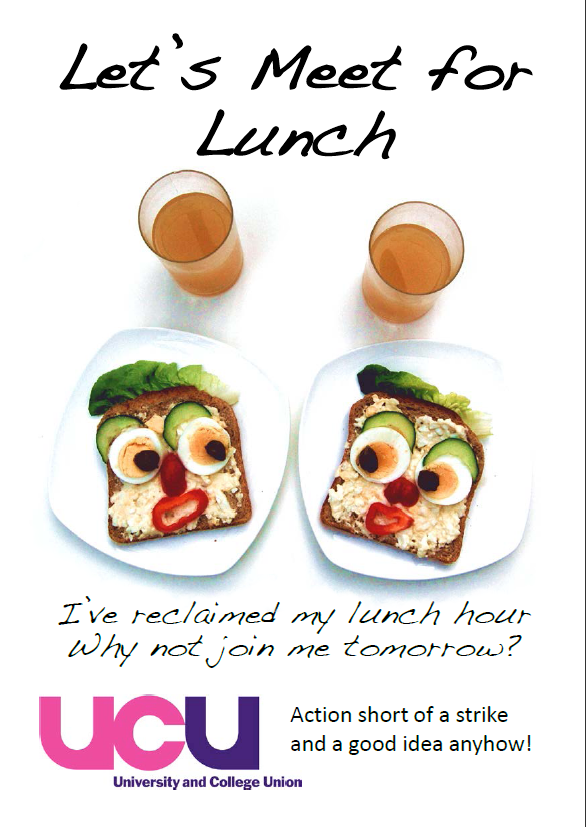
“Let’s Meet For Lunch” Campaign

With recent changes to the USS Pension Scheme, our employers have demonstrated that despite our hard work, long hours, and constant sacrifice, they have no interest in maintaining one of the most important rewards in our profession: the opportunity for a dignified retirement.  They will be paying less into our pensions, our benefits will decrease substantially — and yet, our workloads will continue to increase, our stress levels will continue to rise, and the pressures upon us will continue to intensify.

If our employers have no interest in taking care of us, then perhaps it is time for us to take better care of ourselves and each other.  Rather than giving them a free hour of extra labour by skipping lunch — on top of all the extra hours we work anyway — let’s reclaim our lunch hour.  Let’s take some time every day to slow down, take a break, refuel our bodies and our minds, and socialise with our colleagues.

One of the benefits of university life used to be the collegial nature of the academic environment.  A campus filled with bright, driven people can be an exciting and motivating place to work.  We hope to regain that feeling of collegiality by recapturing the lunch hour.

With that in mind, Southampton UCU will shortly be launching our “Let’s Meet For Lunch” Campaign.  We urge all of our members to take part and reclaim that crucial mid-day break to keep their minds and their bodies in good health and good spirits!

Flyers and further information will be coming soon — here on this blog, via email, and from our members around the campus!