What Are You Worth? The University’s Proposed Pay and Reward Plans

UCU members have already been alerted about the University’s proposed new Academic Reward and Recognition strategy. Details of the proposals can be found at https://sharepoint.soton.ac.uk/sites/arr/default.aspx

When this topic was first raised by Human Resources last year your branch executive were extremely keen to talk about how staff might best be rewarded for all their efforts. Having gone through yet another massive organisational change and stripped administrative and support staff to the bone, and somehow delivered on increased income, high quality teaching and research despite this, we hoped this would be a chance to suggest how the University could show its appreciation for its staff.

However it has become clear that – rather than focusing on the important issue of valuing and recognising staff contribution and effort – these proposals represent an extension of performance management and significant changes to agreed academic roles.

Southampton UCU are very concerned about these proposals. Responding to your feedback we summarise the key issues here:

Much of the thinking behind the proposals is based on the performance and potential matrix – often referred to as “the nine box”.  While certainly a popular way of ‘assessing talent’ this model of Human Resource management it is hotly debated and disputed. (It is worth noting that it closely resembles the asset stripping approach used by the GE–McKinsey to “prioritize its investments among its business units” http://kenhoma.wordpress.com/2011/10/26/.)

The proposals threaten a number of important features of the current pay framework which UCU members will remember fighting for in 2004. First they remove incremental progression. Currently staff progress to the next pay point on the basis of satisfactory performance. This continues until staff reach the top of their pay level or move into the Higher Responsibility Zone (HRZ). While incremental progression is not automatic – increments can be withheld if performance is deemed unsatisfactory – most staff welcome this financial recognition of their continued performance (especially at a time when inflation is running at 5%). Southampton UCU believes that our members want to keep incremental progression.

The proposals, as they stand, potentially break up the job families – by introducing levels of competency within each level the model is effectively splitting each grade. Instead of 7 levels we would have 21- each with pay ceilings and restrictions on progression. Already Human Resources are considering introducing an ‘apprentice academic’ grade which would break the minimum pay point for academic  (ERE) lecturers and would allow the University to employ ‘lecturers’ on lower pay than agreed in 2004. Such an alteration to the job families and levels breaks the nationally agreed pay framework and would effectively mean that Southampton would be forced into protracted, time-wasting local pay negotiations and possibly continual local disputes over pay and grading. (Your UCU executive are perhaps understandably concerned about the burden on local UCU activists and the likely reduction in volunteer members available to undertake casework and protecting other rights for our members).

Given the high volume of casework presently undertaken by Southampton UCU related to harassment and bullying of staff by managers we are anxious that the proposals give considerably more power to line managers, and  open up further opportunities for subjective assessment of  performance and potential victimisation of staff. Alongside this there is a threat to academic freedom as line managers will have control over what is regarded as competent performance, and are free to proscribe certain research topics or activities as they set expectations.

Finally we are concerned that all too often Human Resources and the Senior Management of the University – perhaps because of their own financial position – see wages and promotion as the only motivators for performance.  In our discussions with our members many of them tell us that while they might make more money working in the private sector they have deliberately forgone financial rewards because they want to transmit and develop knowledge and to share expertise with the next generation and fellow researchers. This public service ethos stands in stark contrast to the ‘business models’ currently driving much of the University strategy. Perhaps this is why – during the mass voluntary redundancy exercise of summer 2011 – many of our members commented that rather than seeking personal pay rises they would prefer to keep academic and administrative colleagues in post to deliver teaching and research effectively in the University.  In addition the proposed model assumes that everyone should always be aiming to move up to the next level. We feel that this undermines diversity and flexibility policies and may prevent some from achieving work-life balance – and it also ignores the possibility that highly talented, well-performing staff members might be happy to continue to deliver excellence at a certain level/grade without the desire or expectation to move up and thus increase their responsibility/workload/hours.

We are concerned that like many schemes in the University these proposals are being pushed through too fast with inadequate consultation and negotiation. Following discussions with regional and national UCU officials we have told the University that we are concerned that the University does not appear to be complying with our recognition agreement that matters of pay and reward are subject to negotiation with UCU, and that under our agreements UCU is the “sole representative agency” for such discussions.  We have asked that the Provost and /or Director of HR commence proper negotiations with on the new academic reward and recognition proposals.

As ever – if we are to effectively represent your views – we need your comments and concerns – so please email ucu@soton.ac.uk with your thoughts about the proposed changes to your pay and terms and conditions.


——-

Professor Catherine Pope

Southampton UCU

Save our NHS!

We now have lots of evidence about the changes proposed in the Health and Social Care Bill which will push the NHS towards a system resembling the USA’s.  People within the NHS are desperately worried about the Bill ( see for example the Royal College of GPs survey of over 2500 GPs published last week in which nearly all of them thought bill should be withdrawn or  go to http://abetternhs.wordpress.com/faq/ for a clear statement of the evidence about the Bill.)


This letter contains links to just some of the evidence compiled over the past year (you can click on them to find out more. Please will you  spread the word to as many people as you can. The more people know what’s being done to the NHS, the greater the chance of minimising the damage.


We also want lots of people to write to their MP.  You could ask why the Secretary of State is still holding out on the House of Lords by not revealing the contents of last year’s “Transition-Risk Register” a Department of Health report that was drawn up over a year ago to show the risks of continuing with the Bill? The Risk Register has never been released, despite two instructions from the Information Commissioner to do so. Why are such relevant facts being withheld from the Lords, from parliament and from the rest of us? What’s being hidden? Perhaps the Risk Register agrees with the available evidence, most recently cited by OECD, that the proposed changes may actually reverse the recent progress made by the NHS and make things worse.


Many believe that the competition of a market system improves health care. In fact the reverse is probably true, as research overwhelmingly shows. For instance, there is an incentive in market systems to do unnecessary work.  In the US system, which is the most similar to the one we seem to be moving to, The Economist estimates that 10%-12% of all 2009 health care expenditure went on unnecessary treatment. Privatised systems also require higher management and transaction costs (e.g. for billing). Believe it or not,  international comparisons show NHS management costs to be among the lowest.


Of course our current system has its problems, but what country’s doesn’t? We keep hearing how bad UK cancer care is, for example, compared to other countries. Yet outcome measures have improved markedly in the last decade. Another example: a recent OECD report showed that the decline in avoidable mortality in the UK was the second fastest of all industrialised countries.  A 2011 study shows that the NHS was among the most cost-effective healthcare systems among 17 countries (the USA was among the worst). Another shows that satisfaction with the NHS is at an all-time high.

It’s strange, then, that the media and politicians feed us the opposite picture with a constant stream of stories about the NHS’s flaws. Is that because a cornerstone of the government’s argument for pushing the Bill through is the NHS’s allegedly poor outcomes?


They say that the Bill will put GPs in charge of commissioning health service on behalf of their patients (e.g. drawing up contracts with the local hospitals). But the GPs new Clinical Commissioning Groups (CCGs) will need help to do that. Many are turning to private consultancies to get that help. Some of that commissioning support is to be delivered by insurance companies, potentially the very same insurance companies that have had such a malign influence on healthcare in the USA.  As you may know, quite apart from 50.7 million US citizens who can’t afford the premiums, US insurers ruthlessly ration care, limit doctors’ clinical freedom and often use the small print to refuse to pay out.  It seems that these companies are positioning themselves to run large parts of the NHS in future. Is this really what we want?


We were not given an opportunity to vote on this massive change to our NHS. But we may be able to stop it if enough people take a stand. If losing our NHS makes you as worried as me, please pass the message on in any way you can. Feel free to copy parts of this letter to friends, your MP and anyone else you think needs to know.


It’s not too late to stem the damage.


Professor Catherine Pope

Southampton University and College Union

Invitation to Southampton and Eastleigh Question Time Event

Invitation to Southampton and Eastleigh Question Time

January 20, 2012 at 6:00 pm

Southampton City College 


The University and College Union (UCU) would like to invite you to a special Southampton and Eastleigh Question Time on January 20 2012, which is being organised by UCU and will be chaired by BBC South’s political editor Peter Henley.


A panel of MPs, business leaders and educators will take questions from the audience and discuss how Southampton and Eastleigh can prosper in the current economic climate.   Education, employment, skills, business and opportunities for young people will be some of the key issues debated during the evening


The guest panel will be:


§  Rt Hon Chris Huhne MP – MP for Eastleigh and Secretary of State for Energy and Climate Change

§  Rt Hon John Denham MP –  MP for Southampton Itchen and former Secretary of State for Innovation, Universities and Skills

§  Lawrie McMenemy – former manager of Southampton FC

§  Jan Ward – Chief executive of Southampton based Corrotherm International and Southampton & Fareham Chamber of Commerce & Industry

§  Julie Greer – Head Teacher of Cherbourg Primary School, Eastleigh


Audience members are asked to arrive for 6:00pm. The event will begin at 6:15pm promptly and will last for approximately one hour.  Attendees will be given the chance to submit questions for the panel.   There will be a small reception and chance to chat to fellow audience members and panellists after the event.


If you are interested in attending and would like a ticket, or to submit a question, please RSVP to Lisa Johnson at ljohnson@ucu.org.uk As we only have a limited number of places available tickets will be allocated on a first come first served basis.  PLEASE ALSO NOTE THAT ENTRY TO THIS EVENT IS BY TICKET ONLY.

Attention early-career academics: UCU training courses are being offered in Spring 2012!

UCU will be running training courses this spring in London aimed at members who are new to the academic profession.  These courses are designed to help you to build your career and develop your skills, and are available for free to members.

However, these courses have been extremely popular when offered previously, so if you wish to sign up please do so as soon as possible!

Details follow below:

———————————————————————-

A priority for UCU is supporting our members who are new to the profession and we know that those of you at the start of your career in education want access to training and development opportunities as well as the chance to meet and network with other new staff.

In 2010 we piloted a series of ‘Early Careers’ courses aimed at younger and new staff and the response was fantastic with all events well over-subscribed and a clear demand for future training opportunities. So we’re now delighted to be able to offer this new package of courses for Spring 2012:

All courses are FREE to members but places are limited. Priority will be given to those who have recently entered the profession or who are relatively new to teaching. Please complete the relevant online form below to register.


Starting out: getting the most from your career – 7 March 2012, London

Induction training for UCU members starting their careers in education.

The course will cover the following:

  • your rights at work as a new member of staff working in education
  • learning how to deal with issues that arise in your workplace
  • understanding what is meant by leadership in education.

To register for this course, please complete the online form: Starting out: getting the most from your career, 7 March 2012, London


Speaking up: voice care training – 26 April 2012, London

Strategies for keeping your voice stronger for longer and communicating effectively by developing your voice. A practical and interactive workshop designed to help you find, use, enjoy and maintain your voice. This one-day workshop looks at ways to keep your voice healthy as well as use it to best advantage in a teaching environment.

This course will cover the following:

  • improving understanding of how voice is made and what affects it
  • how teaching staff can best protect the voice, in order to prevent strain and loss. Improved vocal stamina
  • increasing awareness of voice skills in communication.

To register for this course, please complete the online form: Speaking up: voice care training, 26 April 2012, London


Assertiveness skills – 16 May 2012, London

Developing effective communication and assertiveness skills to help develop your career.

This course will cover the following:

  • understanding difficulties in communication
  • developing the skills to deal with challenging situations
  • techniques to develop your confidence
  • developing an action plan for personal improvement.

To register for this course, please complete the online form: Assertiveness skills, 16 May 2012, London

University of Southampton Reward Strategy

We encourage all SUCU members to peruse the following website, which summarises the new Academic Reward and Recognition strategy:

https://sharepoint.soton.ac.uk/sites/arr/default.aspx

Note that this page requires visitors to login using their University credentials.

These pages propose significant changes to the current University reward strategy, including new academic roles and new appraisal procedures, among other things.  Some of these changes are likely to have a significant impact.

Please note that there is a discussion forum available for members of staff to note their views; please add your comments if able, and if you wish to express any concerns which you would like us to take forward during consultation, please contact us at the UCU office (extension 22364, ucu@soton.ac.uk).

——-

Eric Silverman

Southampton UCU President

UCU Union Cities Christmas Party – 14 December

Please Join Us for our UCU Union Cities

 Party and prize-giving!


Date: Wednesday 14 December 2011

Time: 5.30–11pm

Venue: The Studio Café Bar, Nuffield Theatre,

University of Southampton

Highfield Campus, University Road

Southampton, SO17 1TR


Please join us for a drink, a dance, a bite to eat and

find out who has won the £100 Union Cities survey

prize!


Free parking on site after 6pm


Free child care places will available in the fully

staffed, university nursery from 6.30–9pm.

Members will get first refusal on places should they

become limited.


To book a place in the crèche please

contact kbrooks@ucu.org.uk


Stay up to date with the union cities project on

Twitter:@unioncitysoton and check out our

Facebook page: http://on.fb.me/uDtBry

Researcher’s Workshop: Great attendance and great feedback!

Southampton UCU held a Researcher’s Workshop today, intended to provide early-career researchers at the University with detailed information about their rights, the national campaigns focusing on researchers and issues related to fixed-term contracts, as well as current local campaigns around these concerns.

The workshop was very well-attended, with 30 researchers from a variety of faculties attending to discuss their rights and their current situations.  Ronnie Kershaw on the UCU National Campaigns Team ran the proceedings, and Andrew Currie from the Regional Office provided detailed and useful background about the national picture.  Dr Stephen Tarling of the University of Southampton Professional Development Unit gave an excellent summary of opportunities available at the University for career development and training.  Eric Silverman, Southampton UCU President, also ran an interactive session in which attendees gave us some very valuable guidance about where we should focus our energies in future negotiation.

Overall the workshop was an excellent, informative afternoon… but we mustn’t stop there!  Southampton UCU still needs your feedback.  What has been your experience of being an early-career researcher?  What problems have you faced in terms of poor management, job insecurity or career development?  How could Southampton UCU help you, and further, would you like the opportunity to get involved more directly in our campaigns on fixed-term contract issues and early-career researchers?

So please, email us and send us your ideas and feedback!  We’re doing our best to take these issues forward, and your input is extremely valuable in making sure that we focus on the right issues and progress in a way that best benefits our membership.

30 November – A fantastic day of solidarity in Southampton

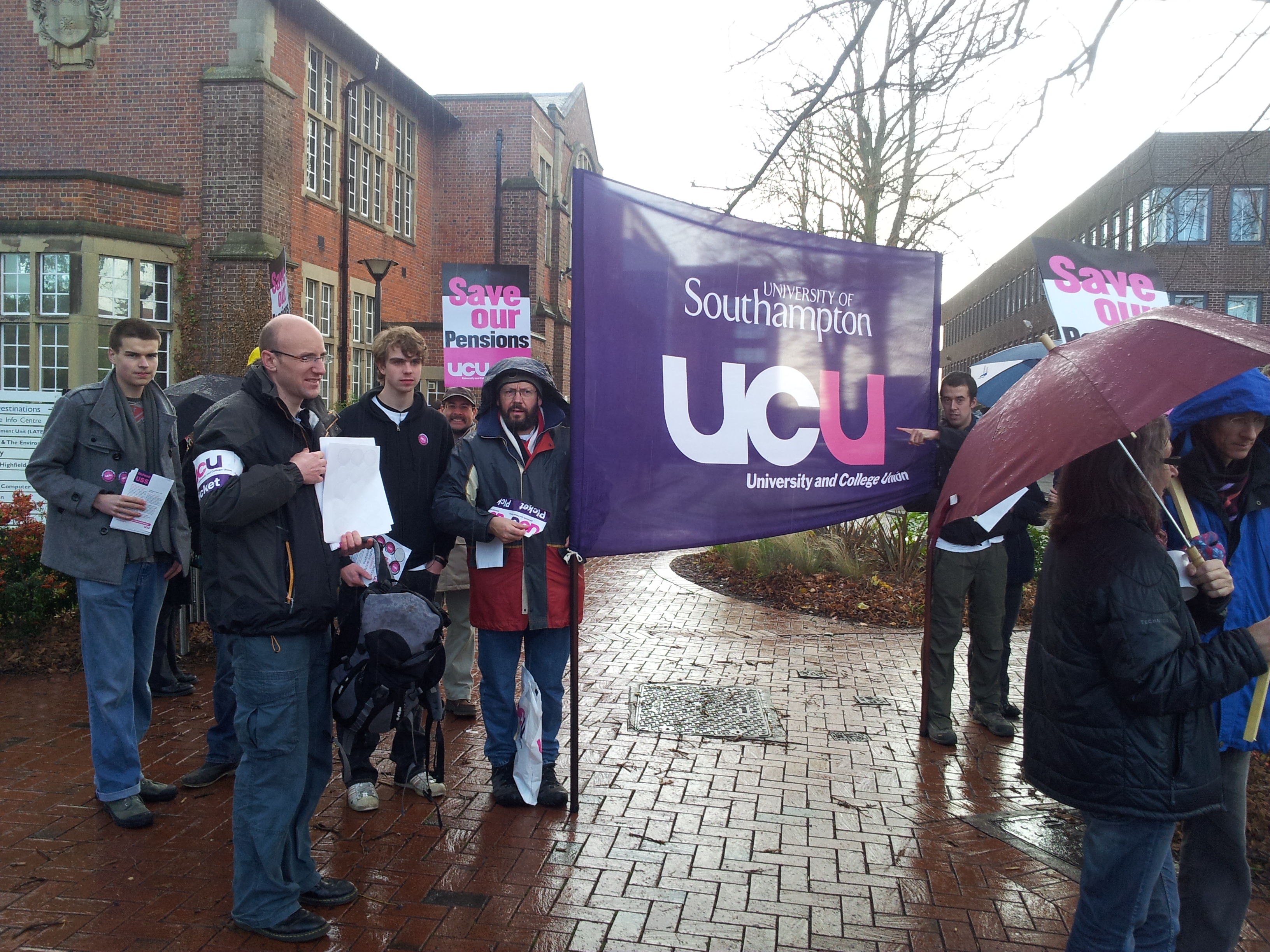
Southampton UCU started it’s day of action early, braving the cold and drizzle to set up our pickets at the Highfield Campus of the University of Southampton.


Soon we were joined by a group of supportive students (the banner reads ‘Workers and Students United’) outside the UCU office, where we refueled, warmed our frozen feet and prepared to march into town….


On the way we saw a striking message left on the Physics building…


And then we marched 100-strong into the city centre, where we prepared to join our colleagues in our sister unions in a march to the rally at Guildhall Square.


UCU had a strong presence in the march, featuring our own large contingent along with colleagues from Southampton City College, Eastleigh College and Southampton Solent.


The march through the city centre was abuzz with energy, as passers-by stopped to wave, shout their support and take pictures.


Finally we arrived at Guildhall Square, where the massive crowd was treated to speeches from representatives of unions from across Southampton and south-west Hampshire, including our very own Professor Catherine Pope.  The gathering was boisterous and enthusiastic, but always peaceful, and filled with optimism.  Hopefully a sign of things to come!

All told the day of action was a smashing success.  We were thrilled at the turnout for the march into town, and our pickets were strong and well-received: we were visited by Vice-Chancellor Don Nutbeam (who later sent us free coffee and tea!), Director of Human Resources Janice Donaldson, Registrar Tessa Harrison, and Provost and Deputy Vice-Chancellor Adam Wheeler.  Everyone engaged us in civil and spirited debate, and expressed their appreciation for our conduct during this industrial action, and we are grateful to them for stopping by and talking with us.

Southampton UCU would like to thank all members who came out to picket and march today, and we would especially like to thank the students who joined us on the march, showed their support all day, and distributed our flyers all around the campus beyond where our pickets could reach — you were all fantastic, and your support means a great deal to us.

A great day without a doubt, both for Southampton and for the country as a whole.  Let’s keep the momentum going!

—–

Eric Silverman


30 November – A statement from the branch President

Tomorrow is going to be quite a day.  A day of action featuring several million people.  A show of solidarity and strength by more than 20 trade unions, including our own.  A demonstration of our collective unwillingness to sit back and watch our benefits get taken away without negotiation.

But more than that, it’s a chance for us to show that we’re prepared to fight back.  To step up when our employers, and this government, decide that they can take away what we have worked so hard for.  To stand in the way of changes done for reasons of ideology rather than need.  To show to our colleagues, our students, and our community that we stand prepared to defend higher education in this country.

The USS pension scheme is the second-largest pension scheme in the country, and is cited as one of the most financially stable.  Even during the current crisis, the scheme is not in terrible danger of falling apart.  And yet, our employers have chosen to attack the scheme, to replace it with a markedly inferior two-tier structure that is unfair to new members, and to increase our contributions while making sure we get less out of it.

Some members have expressed to me the view that, while these changes are a disaster, we should be thankful for keeping a decent pension in the current climate — so why are we getting all fired up? But of course, these changes aren’t happening in isolation; they’re happening in concert with other sweeping changes to higher education that, when combined with the pensions issue, threaten our profession and our universities.  On top of our lesser benefits, our universities are getting their funding cut enormously, meaning we have to deliver more with less money.  Support has been cut for poor students who need financial support to attend college.  University students are now expected to pay triple the amount of fees as before and live the rest of their lives with a mountain of debt.  Along with all of this, lurking ominously in the background has been the promise of changes to university certification, which will allow private education providers — and the predatory lenders who come with them, as we’ve seen in the United States — to enter the sector and change the landscape of higher education forever.

For me, I feel like I know where this path ends.  I come from the United States.  I have $118,000 in student loan debt, which will follow me for the rest of my life and is not dischargable for any reason, including bankruptcy.  I’ve seen the undercover investigations of private education providers, and how they prey on the poor, the mentally ill, the infirm, offering them a chance at ‘education’ but in the end providing only empty promises and a lifetime of debt servitude.  Finally, I’ve seen what happens when unions are broken and when benefits are eroded: workers certainly don’t end up with a ‘good enough’ pension that is protected.  Eventually, as soon as the employers can engineer it, those benefits disappear entirely.  And they don’t come back.

Tomorrow will be a fantastic day, filled with inspiring rallies, glorious marches, and comraderie and solidarity.  But it will also be an opportunity for us to say that enough is enough.  That we don’t want a higher-education sector funded on the backs of students, a sector that preys on its workers and denies them the right to a dignified retirement after many years of hard work.  We deserve better than that.  Our students and co-workers deserve better than that.  Our society deserves better than that.

Please stand with us on 30 November.  Let your employers know you’ve had enough.  The challenges ahead require unity and strength; and the more of us there are, the stronger we are!

————-

Eric Silverman, PhD

Southampton UCU President

30 November – Professor Catherine Pope’s speech

Tomorrow at 12.30PM, following our picketing in the morning, we will be marching down to Guildhall Square for a rally with our sister unions in Southampton.  Professor Catherine Pope, our Equalities Representative, will be speaking on behalf of Southampton UCU.   What follows is an excerpt from her remarks.

———————————————————-

I’d like to say a few words about why UCU – the University and
College Union – is on strike today. UCU is the largest trade union
for staff in the post 16 education sector in the UK. We have 120,000
members in FE colleges, Universities, Agricultural Colleges, Prisons
and Adult education. We are educators, researchers, librarians,
technicians, IT staff and administrators.

Members of University of Southampton UCU branch are on strike
today to defend our pension – the Universities Superannuation
Scheme. Our UCU colleagues in FE colleges are also on strike to
defend their pension – Teachers Pension Scheme. And many of you I
know are here to defend public sector pensions.

By striking we know that we have an impact. Lectures, seminars,
research meetings, and parts of the day to day business of running
the University have been cancelled. This is bad for our students’
education and bad for our research. It is probably also a bit of an
inconvenience for colleagues who are not in the union.

I know that strikes are not a ‘good thing’. That is probably the only
thing Frances Maude and I will ever agree on.

That is why I and my fellow UCU members do not take strike action
lightly. When we withdraw our labour and take strike action we
do so as a last resort. We strike because our employers (and the
government) have refused to engage in meaningful negotiation with
us about our pension.

USS is a final salary pension scheme. We pay 6.35% of our salary into
the scheme. It is the second biggest occupational pension scheme in
the UK and according to its website is ‘one of the largest and most
stable pension schemes in the UK’.

USS is also, in fact, a private pension scheme. It is not a public
sector pension scheme. It is stable and not in serious financial
difficulty. But despite that it is being attacked in exactly the same
systematic ways by the government and our employers as public
sector pensions and that is why we are on strike today: to defend our
pension, and to stand in solidarity with our friends and colleagues in
local government, NHS and Social care, Border Agency, schools and
so on.