More on the PwC review

We have received a reply from Adam Wheeler, our DVC, to our offer to assist with the review:

Finally, regarding your question about the Business Model Review, UCU have received a number of briefings [I think these were verbal reports at JNC/JJNC: Denis] from management on the purpose and scope of the Review and the progress of this work. UCU members have also been involved in the work by virtue of being staff involved in the review. The University will in time seek to engage with the Trade Unions on next steps, once PWC has finished its report.

Meanwhile, I have been chosen as one of the sampled staff to provide data for the review. There is a pretty obvious bias in the way data is requested. There is just one box for time spent teaching; there is another single box for time spent on research. On the other hand, there are 49 boxes allocated to detailed ancillary, administration, and support activities. We are asked, at short notice, to distribute our average monthly hours amongst these tasks, with a granularity of no less than one hour per activity. As I calculate it, based on the University’s assumption of a 35-hour week, we should have 134 hours to distribute. So we will have to scatter ones and zeros around the support boxes. Given that there are lots of such boxes, I can only assume that the purpose of the data gathering is to generate high apparent support costs to justify the purchase of Watson and other expensive outsourced products. To be paid for, presumably, by a further reduction in academic-related staff.

There are, however, a few free-text boxes. Perhaps colleagues might use them to explain the amount of time they spend “fighting” managed print? Or struggling to get a timely and effective response from our already shrunken central services—counselling, legal, and HR come to mind. Or dodging the alarming number of rats that are scurrying across campus.

Denis Nicole

Update on university action against a union representative

As our Southampton members will know, the university recently initiated disciplinary action against a union representative over the way he supported members during a disciplinary enquiry. All three campus unions were deeply concerned; our caseworkers are trained and accredited by their unions and, if there are any issues about their performance, the appropriate behaviour by the university would be to approach a full-time official of the union. In the last resort, the union can withdraw a caseworker’s accreditation. We know the university understands this; not long ago the Chief Operating Officer wrote to union officials querying the conduct of union health and safety representatives. On that occasion, the representatives were promptly vindicated when the system whose safety they had been querying failed spectacularly—think of an indoor version of the Emperor Fountain at Chatsworth.

This casework is a trade union duty protected in law; our caseworkers are entitled to time off with pay while dealing with matters of discipline. Our understanding is that, during this time off, the caseworker should be answerable to their union, not to the employer. We put this to the university in an “Emergency Joint-Joint Negotiating Committee” meeting on 28th July, but the meeting was adjourned without agreement.

I am now able to report some moderately good news. The accused representative has been told that there is no case to answer. They have not, however, been told anything about the accusation; they don’t know its content, who made it, or whether, with no case to answer, the complaint has been judged vexatious. We have been given no assurances that such unjustified complaints will not again be used to harass our representatives in the future.

Our trained representatives are a very precious resource; almost all of our successes in resolving the problems of members depend on their skill and their willingness to give time to support their colleagues. We cannot allow inappropriate accusations by the employer to discourage them from coming forward, nor can we allow a chilling atmosphere of fear to discourage them from pursuing their role tenaciously.

We are thus continuing to press the university to give decent guarantees of protection to our volunteers through a formal undertaking that an incident of this sort will not happen again. We will let you know what happens when the EJJNC reconvenes.

Workload, “Time Off in Lieu” (TOIL) and Unusual Hours

We are receiving a number of enquiries and complaints about changes to workload and patterns of work for staff in levels four to six, where UCU has collective bargaining recognition. At present, this problem particularly affects academic related staff in the MSA, TAE and CAO job families. This paper is an attempt by the Southampton branch to set out what we believe to be the proper approach.

Within the University, there are some established job titles, such as “lecturer” which are automatically appointed at a minimum of level four. Other jobs are graded by “job evaluation” panels, according to the Hay Job Evaluation process, against role profiles negotiated and agreed by UCU. Trained union representatives sit on these Job Evaluation panels. While the detailed scoring process is confidential, important elements of the Hay process are “thinking environment”, which includes the level of direct supervision, and “accountability”, which includes “freedom to act”. Academic and Academic Related staff at levels four and above should expect a substantial degree of autonomy in defining their immediate goals and their work patterns. This principle is included in the role profiles for all roles at level four and above, including job roles in the MSA, TAE and CAO job families.

Your workload over the year is defined by the goals set for you during annual appraisal; this includes the PPDR system currently used for MSA, TAE and CAO job families. The appraisal outcomes should clearly and completely describe what the University expects you to do in the coming year. These goals are not “extras”; if a piece of work is not contained within a goal, then the University does not want you to perform it as it is not aligned to the institutional goals. Some goals may be a bit broad, e.g. “take a full part in supporting the management of teaching”; it is up to you as a professional (with support from UCU if necessary) to identify goals which may, over the year, be insufficiently defined and liable to uncontrolled workload growth. Such goals need to be more clearly defined in the appraisal process. It is essential that you insist on the appraisal describing in sufficient detail all that you will actually do over the year. If your goals need to change during the year, further meetings and update to the appraisal document may be appropriate.

You should also negotiate with your manager about your own “professional development” goals. For Academic staff, the University now offers teaching, research, and enterprise progression pathways in addition to the traditional balanced pathway. It may, however, take some time before teaching is truly as highly valued as research. External funding, research publications, and international “networking” are still the keys to outside promotion offers. You may also find it helpful to serve “the academy” by external examining, refereeing, and organising conferences; negotiate workload to allow for these. If you want advancement through teaching, you may need to be innovative (e.g cloud-based learning) and to develop status within the HE teaching profession (e.g. PFHEA). For academic-related staff, take all the training, broadening, professional qualifications, and travel you can get; keep up to date. All colleagues will need to set aside time for training and personal study if they are entering a new area of teaching, research, or administration. Take the opportunity to discuss promotion with your line manager and seek goals that will help you progress.

During the last industrial action, the University took the view that staff at level four and above work a nominal thirty-five hour week. We thus expect that the goals set during appraisal must be deliverable by a fully effective professional working an average of thirty-five hours per week, and taking their full holiday entitlement. Part-time staff work correspondingly shorter hours. Larger goals than this represent an excessive workload. The University is also bound by the working-time directive. Unless you have individually opted out, you cannot work more than forty-eight hours per week averaged over a seventeen week period, although there are some exceptions.

Most of us work most of our hours Monday to Friday between 09:00 and 17:00; within these hours, it is often necessary for us to be on University premises. Obviously, we need to be on-site for our teaching, for meetings, and to manage staff and students. Our presence may also be valuable at other times to support the working ambience of our professional colleagues. For a variety of reasons, some of our professional work may have to take place outside these hours. That is fine too; it should be recognised in your appraisal goals and, if substantial, your job description. You are not entitled to “time off in lieu” (TOIL) of these hours because they are not “extra” hours; they are part of your agreed duties which, overall, should not be taking up more than an average of thirty-five hours a week. It has been an informal practice in some parts of the University to offer TOIL at level four-plus as a way of managing workload and exhaustion; unfortunately, this runs contrary to the general principles.

It is doubly unacceptable for managers to impose fixed office hours on top of additional evening and weekend working. Firstly, your professional role is undermined by the imposition of fine-grained controls and, secondly, your overall workload is excessive. Even worse, we are starting to see instances in some professional services where paid overtime is being removed from level three staff and the work imposed on level fours because they are “free”. We must not allow this to happen; it is depriving colleagues (often Unison members) of income which they probably need more than us.

If you agree to work outside “core” hours, there are some additional things you should consider.

  1. Caring responsibilities: if you are a parent or other sort of carer, you will already have made arrangements to fit your caring responsibilities to your usual working hours. If you need additional paid child- (or other-) care when you work outside these hours, this should be raised with your manager when the new work is proposed. It would not be unreasonable for the University to pay for it. Other caring responsibilities may be more complicated, but you (we) should insist on them being addressed.
  2. Transport: bus and train services can be very poor at evenings and weekends. If you cannot reasonably get to and from your unusual-hours work by your usual method, the University should pay for taxis. Note that this might incur a tax obligation if the taxis are to your usual place of work. If you normally cycle, it may be unsafe to do so late at night.
  3. Personal safety: some University locations can be problematic late in the evening. You may need to be escorted to the car park, or have a taxi meet you at the door.
  4. Tiredness: it may not be reasonable for you to work the next morning after an evening or night “shift”. This is not “time off in lieu”, it is a matter of health and safety. Indeed, under the Working Time Regulations, staff are entitled to a rest period of not less than eleven consecutive hours in each 24 hour period when working. You might work in a hazardous area, you might be customer facing, or you might simply have to interact with colleagues. It is your responsibility to ensure that you only work when you are fit to do so, using your professional judgement. If you come in while over-tired and snap at a colleague, you can expect to be disciplined for your behaviour, not congratulated for working “heroic” hours.

All these matters should be considered in an equality impact assessment for the proposed “unusual-hours” work if it will become a substantial activity.

We are also finding some colleagues have difficulty arranging leave. It is the employer’s responsibility to ensure that you can take all the leave to which you are entitled; insist on getting it. And again, leave should not be micro-managed or arbitrarily controlled. Any constraints must be based on genuine operational requirements. Furthermore, the staffing levels must be appropriate to allow appropriate leave at times suitable for family life.

Final thoughts:

  1. All these things, including leave policy, should be sorted out at Appraisal time (levels four to six are appraised in January to May each year). They should not be coming up at short notice during the year.
  2. If a block of work is not in your Appraisal goals, the University does not want you to do it. It is not what they are paying for.
  3. If you need help, contact UCU: ucu@soton.ac.uk.

PwC Business Model Review

The University is currently conducting a Business Model Review in partnership with PricewaterhouseCoopers. Your UCU branch has offered to provide input to the review, but our offer has not yet been taken up. Meanwhile, as part of the process, survey questionnaires have been sent to a number of staff. The first version for Academic staff did not have ethical approval and was withdrawn on 22nd July. An amended version was approved in August. Meanwhile, another survey has been sent to MSA staff. That too does not seem to have ethical approval, but it has not been withdrawn. Both ask staff to estimate, at very short notice, the proportion of their time that they spend on various activities.

We are rather concerned about the likely trajectory of this review. PwC have an agenda of their own, The 2018 university, which envisages outsourcing a number of support activities. They also say: Gone are the days of lecturing, tutorials, reading library books and then exams. Disruptive digital technologies are and will transform education forever.  We understand Deakin University in Australia was advised by PwC to invest in IBM Watson to deliver student advice. Yes, that’s the IBM Watson that won the American Jeopardy quiz show. Coming to a student services near you. Meanwhile, Manchester University are cutting 68 IT staff; we have contacted the UCU branch there to check whether PwC are involved.

Denis Nicole

Pay Claim Consultation

The employers have made a “final” offer of a 1% pay rise from August 2015. UCU is conducting a consultative ballot of our membership to find out if we are willing to engage in industrial action to improve the offer. There is some further information here:

and the recommendation from the UCU HE Conference is that we should reject the offer. As I understand it, the core offer is a 1% pay rise. This roughly matches RPI inflation (1.1% in March) and might at first sight look reasonable. Changes to USS (up 0.5%) and NI (up 1.4% on roughly £40,000 of pay because of the end to the opting out discount) contributions mean that our take-home cash will actually be reduced. Allowing for inflation, the value of our pay would fall rather more than 1%.

Our recent industrial actions over pay and pensions have been to some extent successful. In both cases, the employers improved their offer once the action had started. I imagine that well-supported industrial action might improve this offer to maybe 2%, and allow us to stand still in real terms. Currently, the employers can afford it. And our VCs are seeing much larger pay rises.

There are a few extra features to the offer:

  • For most institutions, the lowest paid will receive an additional boost so they all earn a living wage. Not, however, Southampton as our lowest paid have to work a 36-hour week to earn what should be a 35-hour living wage.
  • The employers have backed away from insistence on performance-related pay. Incremental progression within a grade should continue to be routine.
  • The employers showed no enthusiasm for addressing the gender pay gap in the sector.

PLEASE, PLEASE DO VOTE IN THE BALLOT. It’s painless, and a low turnout would make us very weak in negotiations. Here at Southampton, the UCU Committee is unenthusiastic about most sorts of action short of a strike. Often, our management seems not to even notice we are doing it. Examination boycotts have been effective but, at any given time, the burden falls on a small fraction of our membership; boycotts also tend to upset students who should be our natural supporters.

For what it’s worth, I am going to vote for strike action but against action short of a strike.

PLEASE VOTE, BUT ONLY SUPPORT ASOS OR STRIKES IF YOU YOURSELF ARE ACTUALLY GOING TO TAKE PART IF CALLED UPON. We cannot win an industrial action without solid support; voting for action which we do not deliver would just make us look weak. The employers would laugh at us. And next year’s offer would be even worse.

If you are having trouble finding your ballot Email, it looked like this

Date: Thu, 11 Jun 2015 11:29:59 -0400
From: “University and College Union (UCU)” <reply@ucu.org.uk>
To: dan@ecs.soton.ac.uk
Subject: UCU consultative ballot: higher education (HE) employers’ final offer 2015-16

and the voting link was at the bottom of quite a long message. Several members have reported that their Email system incorrectly marked it as spam.

Denis Nicole

Branch President

Things an individual can do to maximise their pension

The new changes to our USS pension are very unattractive. There are, however, several things you can do to improve your position at retirement. Here are the ones of which I am aware:

  • Get into a scheme with better inflation protection. The TPS pension, offered by Post-92 Universities has inflation protection at CPI+1.6%; this roughly keeps up with average pay. Currently (but not for long) USS is in the Public Sector Transfer Arrangements, which allow you to transfer your existing USS pension rights into TPS or, for example, the NHS scheme. As shown in my previous post, this really protects your benefits. The downside is that you will probably have to change jobs. I guess you could, for example, move to Solent.
  • Retire a bit. If you were employed and at least 55 on 1st October 2011, you can retire at 60 without penalty. This is a big deal; if you didn’t meet the age cut-off, your pension would be reduced by about 20% for the rest of your life. The really attractive thing to do is to retire 20% (go to a four-day week and, like me, don’t come in on Fridays) and collect 80% of the pension. If you’ve been here a while, you will find that your overall pay goes up, while you work shorter hours. You continue to accrue pension (at 8/10 rate) and when you finally retire you can collect this and your remaining 20%. An added advantage is that your pension is calculated not on your last year’s pay, but on the best three of your last thirteen years, corrected for inflation. If you’ve been at the top of a scale for a while, your pay has not been keeping up with inflation and you will have a pensionable salary which is more than you have ever earned. An unmissable deal.
  • Pay cash AVCs. The Prudential AVCs give a reasonable return but that’s not the real point. They are a way of deferring and eliminating income tax. Money you pay in is paid before tax. You can later take out 25% of the cash value of your pension tax-free. You can take all the rest out too (there is no longer an annuity obligation) and pay tax only at your post-retirement tax rate. Even better, if you have a retirement pension, the total value of your pot is calculated as twenty times your pension plus all the cash (AVCs and USS lump sum); you can take up to 25% of this entire pot tax-free. This right will be lost for future AVCs after April 2016. You should set up AVCs before collecting any pension; the government doesn’t like to see pension money recycled.
  • Don’t forget the various bits of state pension and any other occupational pensions you may have.
  • You don’t ever have to retire. Keep your job as long as you want, and can do, it.
  • Get married to somebody young. USS will pay them for life after you die. Kids (potentially up to age 23) get paid too.

There are a couple of other important benefits which I hope will not affect you.

  • Ill health retirement. If you think this might affect you, do not resign. It is a complicated matter and you need UCU and USS advice before taking any action. If you have only a small pension, your family will be much better off if you stay employed and die “in service”. Resignation also seriously harms your chances of getting an enhanced pension through ill health retirement.
  • You should fill out the “nomination” form from USS. This will ensure that, in the event of your death, your dependent will get some money right away. If you don’t, there will likely be a delay and they might have to pay probate costs before receiving anything.

Denis Nicole

USS Pension Consultation

The formal USS consultation on the revised pension closes in two days time this Friday. Please take advantage of your opportunity to respond. They don’t make it easy (they wouldn’t, would they); you need your USS member number and your National Insurance Number. You will be able to find your member number on any official USS correspondence, including the invitation to respond, or you can call University extension 22445 and ask. You then go to this web page (https://www.ussconsultation.co.uk/members/sign_in) and sign in. Realistically, comments at this formal stage can only affect details of the proposed scheme; we have already reached (reluctant) agreement about the core of the changes.

I’d caution you about using the various benefit calculators; I have seen three (UCU, UCEA, USS) and they all make different fragile assumptions.

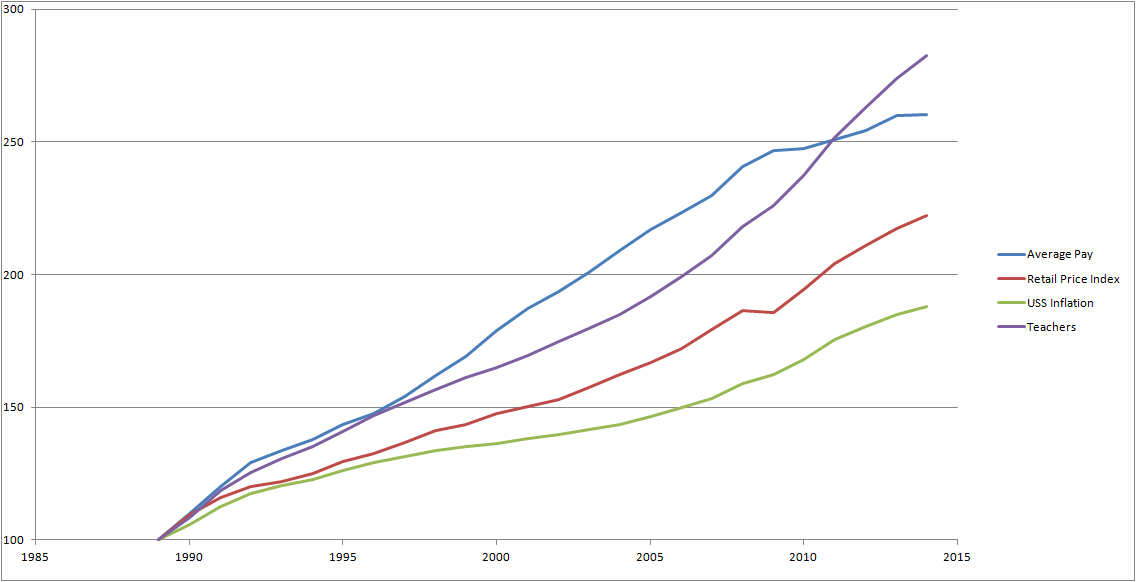
The hard core of what has been imposed on us is the  inadequate inflation protection. They call it USS inflation and it is slightly worse than CPI (with restrictions above 5%). The graph below should explain the problem. It’s based on ONS figures and only goes back to 1989, as that’s the first date of official CPI numbers.
USS_inflationClick on it if you need a bigger version.

You can see the problem at a glance. If we had no career advancement and no annual increments, we would expect our pay to rise at the same rate as average annual pay in the UK. Thus even without annual increments or promotion, we would expect the 1/80th of a £20,000 salary that we earned in 1989 to be worth £650 if it were based on final salary, as average pay has multiplied by a factor of 2.6 over the period. In contrast, USS inflation (capped CPI) has only multiplied by a factor of 1.88 over the period, so even with the improved 1/75 accrual rate, you only get a pension of £501 twenty-five years later. You lose even without taking account of career progression. The teachers, in TPS, have negotiated inflation protection of CPI+1.6%; this roughly keeps up with average pay.

Why did the teachers get a better deal? Perhaps because of greater Union strength and militancy. The sad reality is that our scheme is supposed to be fully funded; there is meant to be enough money in it to pay our pensions. That allows the government pensions regulator, the USS staff, and the USS trustees (typically from the banking and government sectors) to impose very conservative actuarial assumption to force down benefits. They have even adopted de-risking which is banking-talk for deliberately selecting worse-performing investments which make the deficit bigger. And they have imposed a defined contribution section because, in their language, it is risk-free. It’s risk-free because we take all the risk. The teacher’s scheme, on the other hand, has no money at all, so they don’t have any actuarial rules to follow.

So what can you usefully say in your response? Feel free to rehearse the sad story above, but I doubt you’ll get far. I would concentrate on the defined contribution component, and address a couple of key issues:

  • The new USS is a very complex hybrid scheme. There is legacy final salary, legacy added years AVC, Prudential AVC, CRB, DB (with optional extra matched and unmatched contributions) and possibly a further cash purchase AVC option. This all gives the scheme staff an opportunity to spend money and impose fees. Insist that the fees on the DB parts of the scheme be kept low, well below the current 0.84% average as we are a very big scheme which should be very efficient.
  • All the risk in the DB part is carried by us, the members. So we (not the trustees) should be able to select the range of investment vehicles on offer. A member-led panel should be created for the purpose. We are likely to want various sorts of ethical and low-fees funds.

Here are some other suggested responses:

Denis Nicole

UCU Elections

You should all have received Electoral Reform Services ballots for the UCU elections. It is very important that you vote now; your ballot must be received by this Friday 27th February. There is something of a power-struggle in UCU between the “hard” Left (who seem to be associated with the old Socialist Workers Party) and the “mainstream” (who sometimes call themselves the Independent Broad Left). Currently, the Higher Education Committee and the other principal negotiators are led by the “mainstream” and I personally think they are doing a pretty good job under difficult circumstances. When I vote, I take care not to vote for UCULeft-backed candidates; I think they are divisive and tend to pursue wider political objectives to the detriment of our members’ interests. But that’s just me; you should, of course, make up your own minds. But VOTE. None of us are happy with the USS settlement; it is indeed a worse deal than the one the teachers and post-92’s managed for TPS. This is not, as commonly assumed, because of the accrual rate: our lump sum roughly compensates for their faster accrual. The difference is that the teachers managed to negotiate much better inflation protection. They get CPI+1.6%. We get CPI+0%, subject to some additional caps. We did, however, push the employers further than USS and the Government wanted to go. Getting any more would have required us to force, through industrial action, a government back-down. Could we have done that? I doubt it; our industrial strength is limited. We have four problems:

  • We don’t have enough members. Southampton is one of the bigger branches, but membership is nothing like universal. Could we “bring the University to its knees”?
  • Our members can be reluctant to take action. That’s a pity. Effective industrial action requires a membership who will act as a well-disciplined army; all must be willing to turn action on and off at short notice as required by the ebb and flow of negotiations.
  • Our house is divided; the hard left spends congress sniping at the leadership elected by the majority of members. Congress decreases our credibility amongst employers.
  • Unlike tube train drivers and teachers (parents have to stay home from work), action by university staff does not have an immediate impact on the general population.

The first paragraph might sound a bit hostile to the hard left. I’m particularly cross with them right now as they have exploited UCU’s rules (it only needs twenty branches to call one) to force a Special Sector Conference in Manchester tomorrow, and three of us have to spend the day there to vote against motions criticising our elected leadership. Apart from the public embarrassment—some at USS and EPF must be laughing—our membership fees are being frittered away on travelling expenses, probably about £200 each for 120 delegates, and booking a room at the Britannia Hotel. I’d guess an overall cost around £30,000.

Denis Nicole, Branch VP.